Showing posts with label Vicksburg. Show all posts

Monday, July 1, 2019

Reputation

Sometimes, it is a good thing to be known for your work.  When I was first trying to get into beekeeping, I talked to anyone I could find, trying to get the word out that I would pick up swarms and re-home them. I gave out my phone number, I made up cards and handed them out, I talked to officials and wrote blog entries and tried everything I could.

My phone insisted on not ringing.

As I have done more jobs, I have had word of mouth spread a little.  More people know that I remove bees from houses, as people who have had bees removed start to tell others.  It is a slow process, but one removal at a time, the word gets out.

Sometimes, it is a good thing to be known for your work.  And then, there are the times that you build a reputation without meaning to.

I was in a meeting today with some folks from the Vicksburg District, whom I have known by reputation, but had never met.  We are talking through the different parts of the water resource problem they are trying to solve, and we get to the end of the conversation.

I casually ask if he has a side hustle as a pest control guy.

He was.  Is no longer.

Someone else brings up that as long as he doesn't spray the bees, I will be happy.  They explain that I keep bees.

(Side note - I have a self-imposed rule that I am no longer allowed to provide unsolicited bee facts - my colleagues have been patient so far, but there is only so much listening-to-the-five-year-old-reciting-dinosaur-facts that should ever be allowed in the workplace.  I have, therefore, given myself a bit of a stick...)

Now that I have been prompted, I start to explain.  And we talk about bees for a while - he was a hobbiest beekeeper and enjoyed the process...   and sudden-like, Johnny leans back in his chair a little and says,

"You know, it was the craziest thing.  I live over in Belle Meade (my neighborhood), and one day I was out in my yard and I saw a guy in a truck in a bee suit."

There was no way to change the topic of conversation at this point.  And there was no way that I was going to get out of this story unscathed.  I knew the event he was referring to before he told the story.

"All of a sudden, the guy jumps out of his truck and starts swinging his arms around, swatting at bees.  It was the dangdest thing.  After a while, he had shucked the suit off, slung it in the bed of the truck, hopped in the cab and took off."

All of my co-workers were staring directly at me.  I avoided eye contact through the whole story.

Finally, my shoulders slumped ever so slightly. "It was me."

That day, I had opened my most successful hive, with the intent of stealing a single frame of brood to help out a struggling hive down the road. The girls were in a bad mood that afternoon, and no sooner had I opened the hive than they boiled out, intent on my destruction.

It just so happened that I had not done a full inspection of my gear before suiting up to rob the hive.  And I had failed to notice a small tear in the mesh covering my face.  The boiling-mad bees stung my unprotected hands a number of times, and I take my frame of brood and flee.  They follow with the fury of a toy-deprived two-year-old, screaming at me and hitting any soft spot they could.

I brush as many off as I could, and I hop in the truck.  Too many bees still occupy my space, and they are still mad.  I have no opportunity to unmask, so I start driving, window cracked, and the bees are STILL furious.  Still intent on our mutually assured destruction.

A block down the road, a bunch of them have worked their way through the slit in my veil, and start congregating on my face.  Hitting me, sitting on me, pointy side down. Every one of them taking great delight in the pain that they can inflict.  I took a few stings in stride.  I never think of it as the fault of the bee:  I was too rushed;  I was clumsy;  I moved them into a place they didn't want to be.

But these girls?  These girls were hot.  And they hunted me down, and made me pay.

The sixth sting on my face convinced me that whatever it was I was hoping for was not going to happen.  They were not going to calm down.  They were not going to leave me alone.  They were not going to fly peacefully out of the window.  I slammed on the brakes in the middle of the intersection, and jumped out of the truck.  It was at this point that I was observed by Johnny, flailing and swatting and screaming curses to the sky.

In the words of Mark Twain, Let us draw the curtain of charity over the rest of this scene.

Years I have spent, trying to gain a reputation.  I have even invited coworkers to work with me, to see how a calm demeanor really makes all the difference with working with bees.  I have done careful work, making sure to clean up after every job, taking the stings in stride, learning to work with the bees, trusting the bees, understanding the bees....

Now the only mental image that anyone in my office will have of me is of a cartoon - the guy whose bully bees beat him up in his own truck.

Friday, June 7, 2019

Love on the Battlefield

The setting of the National Cemetery at the Vicksburg National Military Park is one of the most peaceful ones imaginable.  The rolling loess hillside, graves in neat rows, each section terraced to provide a continuity among the gathered dead.  Oak trees, expanded to their full canopied width.  Magnificent magnolia trees, filled with heady blossoms.  Ancient crape myrtles and ginkgoes filling in the space.

And one very large downed tree, two terraces distant from the road.

Captain Dan Harder, a friend of mine from my time in Puerto Rico, texted me just before Memorial Day.  "Was at the national cemetery this morning putting flags out; apparently they have a giant tree that fell during the storm they can't remove because it's full of honeybees."

I had a quick conversation with the Superintendent of the park, and confirmed that they were interested in having my help.

Turns out that the giant tree was really a bigger job than I was able to do solo.  Everything I have worked to date has been able to be cut through with a reciprocating saw.  This sucker was far bigger than that.  Fortunately, Aaron Matthews, a friend of mine from work, is looking to get into bees, and offered his chainsaw prowess to the task.

Chainsaw work on the fallen tree stopped where the bees began.
Recon visit didn't tell me much, other than the size of the tree and the size of the entrance.  This is where it gets interesting.  If the bees are only in the very front of the entrance, and fill a space a little bigger than a breadbox, then I don't need to have a chainsaw.  But if it extends back further, I will need the help.

I veiled and reached in to pull out some of the debris in the entrance.

The bees, not unexpectedly, were more attached to their debris than I had anticipated.  Several expressed their displeasure in a very firm manner.

Signs of aggression, check.


Who could blame them?  The opening that they had was a knothole 20' up in a tree.  Now it is basketball- sized hole at a level that any passer-by could reach in easily.  That kind of situation would put any of us on edge.

I returned a week later to try again.  By now, the numbers had increased, and they had covered over some of the external comb with propolis, and they were even more ready to take swift action than before.


Bees covering the full entrance to the hive.
The wood has started to deteriorate, and is soft and crumbly.  They won't be able to stay here much longer anyway.  And as soon as the National Park Service can get the honeybees out, they can take away the tree and dispose of it, and straighten up the graves that were knocked around when the tree fell.

The interior of the log is covered with bees on every surface, and I did not have a way to figure out how deep it goes. 

Only one way to find out.  Reach the hand in and start cutting comb out.  And keep reaching in until there is no comb left.  The hope, of course, is that I don't run out of reach before I run out of comb. As soon as I have cut comb as far as I can reach, we have to move to using the chainsaw.

If the bees do not like people messing with the debris at the entrance to the hive, they REALLY don't appreciate solid chainsaw work.

The all-important selfie.  Obligatory.
One more visit yielded only a little more information.  The bees definitely extended further than I had originally thought.

Saturday started off cool and overcast, which meant the bees slept in, waiting for things to warm up before heading out to forage.  At 9 am, Aaron and I arrived, chainsaw and shop vac in tow. With a borrowed generator from the Military park folk (thanks for coming out, Auston!) we got started.

The initial foray into the hive was daunting. I have been chased by bees before, and I have had an entire hive mad at me before, but this was impressive.  The bees just boiled out of the hive, and enveloped both of us in a cloud of bees that overwhelmed us from the first cut of the comb.

I guess it makes sense.  The bees had been safely ensconced in a tree, safe from the elements and from predators.  I imagine that they lived a peaceful life, with no particular aggression needed to keep them safe.

Then suddenly, as Auston put it, God got mad at 'am, and suddenly they are living in a log that turned their hive 90 degrees on edge, and opened both entrances to the elements.  And to predators.

Auston told us, "Since they can't get mad at God, so they get mad at you."

And get mad, they did.

I looked down and did a quick count.  60 stingers in the back of my glove. Where I leaned forward to reach into the hive, the bees stung my cheeks through the veil.  Four times.  Another half dozen stings hit my hands through my double-thick leather gloves as I reached in.

For an hour, I cut away at inaccessible comb while Aaron helped keep the smoker fueled and fired up to help calm the horde.

Before the log fell, the bees had drawn comb vertically in the hollow of the trunk.  When it fell, that comb is now horizontal - not the bees' preferred position. So they sucked the nectar out, abandoned the use of those parts of the comb, and began drawing comb from the top of the log, and connecting it to the now unused comb stacked at the bottom.
Cross combing
Even so, they maintained the spacing that they needed to do basic housekeeping. So everything is stable, but also built at cross angles to everything else.  Cross angles make it impossible to remove comb cleanly.

And the bees that are now defending the wide open entrance are VERY defensive.


After the first cuts were completed, we pulled enough brood comb to start the bees in their new digs.  Once the box was filled up, we transferred all the comb to Aaron's new bee yard, and ran the vacuum for the first (of three) times, collecting some 15,000 bees in the process.  All of whom got transferred to their new hive.

Very quickly, I ran out of space to work, and Aaron started up the chainsaw.  The top entrance of the hive was quickly liberated, and the entrance in the base of the log widened, so that I could get at more of the comb.

Video taken with a potato....

Twice more, we smoked the bees to the entrance, and twice more, we removed the bees with the vacuum, transferring them to the new hive.

Final step was to feed the honey back to the bees, so they could use it to build the comb in their new box.

I used my newly-acquired Square (TM), and received the agreed-upon funds from the National Park Service. (#SquareOne, #contest).  The transaction was very smooth, and completed the full project perfectly. 

Bees defending high ground
In the final analysis, this was the most aggressive hive I have dealt with.  Possibly also the most bees.  Normally, once I get the entire area open, the bees will settle down and I can work more comfortably, in long shirt and pants with a veil.  These guys would have none of that.  I wore full gear the entire time.... only working without gloves towards the end.  Even then, the bees were feisty.

But I hope that gives them a fighting chance, as well.  We salvaged as much of the cross-combed brood as we could, with which they can raise more bees.  But even so, it might not be enough.    I'll be talking to some friends about installing a queen (we never spotted her) to help the hive establish.  But we'll give the 40,000 relocated bees a few days to build comb and make the hive their home.


And when we do, I'll update you all on the progress.


UPDATE:
"There are 3 bees left."

That was the message I got last night, four days after we removed the hive.  The bees absconded. A large number of them apparently died, within a couple of days of removal, and the bodies piled up.  And the remaining bees took off, leaving an empty hive.

I am going to get a handle on the relocation piece of this business one of these days.   It still seems like such a hit-or miss strategy I employ.  And sometimes it works.  Other times, not.  I usually come up with an after-the-fact explanation (too cold, too slow to move them, too long in the heat, induced robbing).  But the truth is, I am not always sure I know.  It is guesswork.

I need to guess better.

Recent Arrival

"How long has the hive been there?"

Whenever I am answering a request to do a honeybee hive removal for someone, I have a series of questions I ask.  Did you spray them?  How high are they?  Are they aggressive?  Are they getting inside?

I just added the question above to my list, because the answer can change the expectation of what I have awaiting me when I open the wall.

This week was a simple removal.  Bees in the Eaves. An easy cut out of decaying soffit, a quick reach in to cut out the comb, and then it is just a matter to separate the comb with honey (almost a certainty, at this time of year), box up the brood comb with rubber bands to hold it in place, and vacuum up remaining bees.

In this instance, it was even easier than that.

Ty Wamsley had been my office neighbor for a couple of years.  He was the director of the Science and Technology section of Mississippi Valley Division, and so I was delighted when I got his call.  Even more so when he wanted to talk about bees.

After looking over the site, I was convinced that there was very little space for the bees to have expanded to, and so started the cutout carefully.  I tore off the plywood to get at the cavity, and found quite a bit of clean, bright comb. The space appeared very small, consistent with what he had described. After removing the first couple of pieces of empty, new comb, I cut out first one piece of brood comb, and then another.  And then the third.
Video recorded with a potato

But no honeycomb.

In all, I cut off a dozen pieces of comb, total.  Only four of the pieces had been used for brood, and those were still light enough to be pretty.

This was a recent arrival.

Apparently, some time in the past month, some seriously docile bees (hooray for docile!) had swarmed into his house and made their home.  They made a conscious decision to swarm, and then agreed on where the new home was going to be.  Ty's house was the winner.


This is where I get to geek out a little.  Honeybee decisionmaking process is so much cooler than anything we use to make decisions.  One day, I am going to run an experiment where we replicate bee decisionmaking in one of our Corps projects, and see if we get different results.

Bee process starts with population pressure.  Once the bees have filled all of the available space in their current digs with comb, and they have filled that comb space with a combination of honey, pollen, and brood, they get to feeling the population pressure.  When they do, the queen picks a whole bunch of recently emerged bees, and takes off in a swarm. When the queen leave, she is accompanied by about 60% of the bees in the hive. (That is a HUGE hit for a beekeeper, who mostly just wants those girls for their sweet, sweet products)

As soon as they leave, and sometimes a little before, scout bees head out to do recon.  They find a place, and come back to report.  And they report with the famous "waggle dance", first decoded by von Frisch in 1949.  The figure eight dance (swing yer pardner, round ye go....) gives direction and distance, and communicates GPS coordinates to the bees that are 'listening'.  Those bees go and check it out.  If they like it, they come and give the same dance.

If they don't, they find another, and come back and give different coordinates.

The cool thing is this: THEY VOTE.

As more and more scouts return to the group, they dance their vote, and at some point, the group gets enough votes to make the move.  And they decide, en masse, to make the move.  And they swarm.

The queen can only make it a little ways.  She's fat and not used to exercising (like me), and after a little flight she takes a rest.

Eventually, she arrives and they immediately start building clean, white comb for her to lay eggs in.  At around 1500 eggs a day, eventually she fills up the space with lots of bees.  And those bees fill up the space with comb. And honey and pollen.

If you don't have lots of honey and pollen, it means that the bees are either a) struggling from a lack of resources, or b) they are just starting out.  Beginning of spring, no flowers, I'd choose a).

But late spring, I am guessing b).

The numbers of bees in Ty's hive were impressive.  And I expect that by the end of the day, the foraging bees will be coming home.  When they do, I can close up their entrance and transport them to the house. 

But I would have had a different expectation when I opened the wall, if I had just asked the right question.  Ty responded, "You know, I don't know.  I think we first noticed them about a month ago.  But it might have been longer."

A month seems about right.  Enough time to have bumped up the numbers of bees, built enough comb to get busy, and not enough time to actually fill the comb with honey.  (Well, maybe not...)

So, next time, I will ask.

The bees were boxed, and were set aside to allow all the foragers to return.  The next day, they will find themselves in a new home.  One that I hope they will learn to love.


***********************UPDATE*****************************************

It is pretty much guaranteed, that when I read about bees, and then use my knowledge and logic to make a decision, that:
A) The bees have not read the same books, and
B) The bees do not use the same logic.

I set the box aside so that the bees in the box would care for the brood, and that the queen (whom I had hoped was in the box, as well....) would keep everybody in the box.

I grabbed the box the following morning - while it was still dark out - and one bee walked out.  I figured that was a good sign, and hustled them to their new home.

I opened the box later in the day, and that was the ONLY bee that had remained behind.  The rest had followed the queen somewhere else.  Somewhere near Ty's house is a new hive of bees that are struggling to build comb and survive.

It turns out that they heard about the fact that I charged rent for staying on my property.  And they figured it was better to be a squatter in a tree than a tenant in a box.

Ah, well.


Friday, May 24, 2019

Pretender to the Throne

She has no claim on this throne, but she went in, nevertheless.

2 queens, 2 cages, 3 nurse bees to help out. 
$37.50 each.
Last Saturday, I bought a nucleus hive and two queens from my mentor.  (A recent flood had taken out a bunch of his 'nucs', and he only had one that he could sell me.)  But I had two different hives at the house that needed to be re-queened.  One had lost the queen because of an accident.  The remaining workers had hustled to raise up a queen, but with no success. Another was of a removal where the queen had not transferred.  I had tried to help both of the hives by sharing some brood from my successful hives, and had managed to keep the numbers high, but they had not had a queen successor to take over.

"Talk me through the process."  I asked my mentor for help.  Books are fine for background, but my bees don't read the same books, so I like being able to ask specific questions of people who do this professionally.

"First, go through the hive and make sure that you don't have any queen cells.  Then, spread your fingers like this (looks like a deck of cards between each of his fingers), and use that space between the frames to put this box in.  The workers will eat their way out, and the other workers will eat their way in.

"If, after four days, they haven't released her, pop it open and let her out manually."

Simple enough.  I had inspected the hives just the previous day, and there was no queen cell present.  It had surprised me a little - I had hoped that I would be able to avoid the $40 expense of buying a queen (each...).  But such is life.

I did as he said, and then left the hives for a couple of days.  The nuc I installed into a freshly painted hive, and left them running their lives on their own.  And this afternoon, I went out to release any queen that needed a little nudge.

First hive, opened up with a slight puff of smoke, and looked down into the hive.  The queen cage was still intact.  I pulled the tape off the edge, and pulled the plug - still filled with bee candy - and watched as the queen marched out and disappeared down the side of the hive.

Sweet success.

Emboldened by the ease by which I had just watched that happen, I opened the other hive, and peered inside.

Same story. The workers had not eaten through the tape and candy to release the beautiful queen.  So I repeated the process, cleared the dead bee from the entrance to the box (just like the first one) and watched as the fat-bottomed girl walked over the edge and disappeared.

Sweet success, part two.

I grabbed one of the other frames - one that she had NOT just walked down the face of, and glanced at it to see how much honey they had put on the frames.

Brood.

Wait.  Brood only happens if you have a laying queen.  There can't be brood in this one, because I don't have a...

OH, CRAP.

A gorgeous, fat, bright, yellow queen strolled across a frame of perfect brood.  I watched in horror as she walked to the edge of the frame and disappeared over the edge. I had just released a second queen into a perfectly functioning hive.  They HAD replaced the queen that had been lost.  And I had just spent 40 dollars needlessly.  Worse, I couldn't even go back and find the pretender.  Or the fat girl I had just seen.  They completely disappeared.


To clarify for those who don't know: one hive, one queen.  Honestly, I would have expected more resistance to the entry of the second queen.  But the other workers simply ignored her. So I don't know what happens next - whether there is a battle to the death, followed by a Quickening, or whether the newly introduced queen just gets ignored and starves.

But I can't worry about it too much. I have another removal tomorrow (for which I wish I had saved the queen) and another the following week.  I have to get ready.  And next time, when I am told to inspect to make sure there are no queen cells...

...you better believe I am going to do it, and that I am going to be thorough.  

Monday, May 20, 2019

The Beverly Carol - a B&B&B

It seems as though working at heights is my go-to job now.  Once again, I had a bee removal effort in Vicksburg, where the elevation of the job just gave me pause.

The entrance to this hive at the Beverly Carol - a historic home in the downtown area of Vicksburg,  was high on the exterior wall - right at the corner of the building.  Below the entrance was a three-and-a-half story drop.
The bees are somewhere near the top.  I can't even look.

It was not the sort of job I was looking forward to.

Immediately, I looked for alternative solutions.  After a little while of trying to figure out my options of ladders and scaffolding, I asked the owner if I could see inside.

The location interior to the hive is a laundry room, and one that is a later addition to the lovely 1910 house, now turned into a B&B.  Well, maybe a B&B&B....

It appears that a second-story balcony was enclosed, siding put on the outside, and tongue-and-groove flooring used as paneling for the walls.  Pretty solid.

But the proximity to the hive meant that it would be a perfect way to get at the hive without facing a three-story drop.  I provided Mrs. Jenkins with my estimate - the lowest amount that I charge for removals - based on the expected effort to remove a small infestation in a small corner of the building from the inside.

Easy peasy.

How hard can it be?
I know better than to ever say those words out loud.  Nothing is EVER easy peasy when it comes to bees.  And speaking the words means that the task is immediately more difficult than you can manage.

So I sealed the room with plastic sheeting - to keep the bees from going out the door and into the house - and got started.

Getting started is often the hardest for me.  I'm not sure what it is - might just be the spankings I got as a kid - but I just don't want to damage anything.

After finally breaking loose the corner molding, I was able to open the hive.  Just the corner.  And some excited bees made their way into the room.  Curious - not angry, but intent on evaluating the threat.


The tongue-in-groove paneling was locked into place in the corner, and resisted easy removal.  So over the next half hour, I struggled to remove the wall to get at the comb.  The area was almost certain to be a small one - there was just not enough space in the corner to hold a hive of any real size.

I finally decided that removing the molding around the window would allow me more access, and I pried it loose. 

Opening the wall.
The hive was not relegated to just the corner.  It turned out that this was an enormous hive, extending for about eight feet to the right of the corner. The comb next to the entrance was mostly dry, having held honey that had already gotten sucked down during the winter.  But an opening down below allowed the bees to expand.  And expand.  And expand.

A sawzall quickly  came into play (by the way, bees HATE the sound of saws), and I cut down the wall at the edge of the exposed comb, and exposed additional an additional five feet.  The area covered by the bees was phenomenal.

There was dry comb on the left.  There was nectar on the margin. And then rows and rows of brood - baby bees just waiting to be born.  Comb extending down four and five feet below where it was connected to the wall.

Baby bees, including several
peanut-shaped queen cells. 
Baby queens, ready to emerge.


This extension created a huge problem for transportation.  If you had asked me 20-questions about the hive before I started, I would have had a hard time guessing whether it was bigger than a breadbox.  That was about the size I expected it to be.

Instead, what resulted was much bigger than what I had the ability to move.  I came with equipment to stage and transport bees in two boxes. Those two filled up before I got done with the first segment.  The rest was choosing what pieces to save and which to discard.  Eggs for boy bees?  Discard pile.  Honeycomb with nectar in it?  Crush and strain, and then feed the remnants back to the bees.  Eggs of girls (worker bees)?   If they are in good shape, save them.

I cut and parsed and discarded and set aside a LOT of comb.  Anything that I did not put back in the hive got melted down to make wax - I should have quite a lot of lip balm available pretty shortly.  Maybe some mustache wax, too....

I did get some video of the removal of the comb.  The hyperlapse function of my camera was a good way to capture it, since it took forever to complete the job.


It took the whole day.

And then the next.

Cleaning the sticky leftovers took quite a while.  But the bees were promptly installed in the home bee yard, and are now happily buzzing around in their new home.

The Beverly Carol dropped a B - they are no longer a B&B&B!

(Or maybe they dropped an E - from the Beeverly Carol).


Monday, March 11, 2019

Duff Green Removal, Part 2 (Or How I learned to avoid the sting and love the bomb.)

So most of the time, when I get a call to remove bees, it is because the bees have begun to migrate inside the house.

Not this time.

This was the second hive removal from Duff Green, and the one that I was most worried about.  With the first removal, I was able to stand, kneel, sit, stoop, and walk around the hive until I was able to pry the eave bracket from the wall.  The closest to danger I got was dropping the four feet from the roof to the balcony.  Significant risk to my pride, but no real consequence, since nobody was watching me do it.

The height of the second hive, combined with the fact that there was no easy access, meant that I needed help.


Help came.
Boom.
With the assistance of the truck, I was able to spend my attention on the bees, rather than whether I was able to keep my balance on an extension ladder. 
The hive was visible on the outside of the building, certainly a result of the hive running out of space inside one of the two eave brackets on either side of it.  The comb was attached to both, so it could have been either one.... and I was hoping for the one closer to the truck.  Otherwise, I would be reaching out around the corner to proceed.

But first things first, I started cutting down the comb.

The comb on the outside of the building was very friable.  The bees had sucked out all of the goodie from the comb, leaving a dry waxy husk.  The second and third layers were the same.  Brightly colored comb, with minimal evidence of use.
Two sections removed.  Photo: Kathe Lawton
Then the bees started appearing.  It was a cold day, so there was minimal activity.  Mostly just a couple of flybys telling me to buzz off.   At this point, Mr. Wright, who had accompanied me in the lift up until this point, decided that the roof was a better place from which to direct and observe.  


Each of the successive sheets of comb had more brood and bees on it, and the girls got a little more defensive with each step.  But at the end of the ten pieces of comb, I cleared off the remaining bees to figure out where the entrance to the larger part of the hive was, and I found...


Nothing.


The bees were not accessing the inside of the structure at all.  Like wasps or hornets, they had built the entire thing on the outside of the building, exposed to the elements.

As a result, they were not as strong as the group that had hunkered down in the eave bracket.  Their numbers were reduced, and there was maybe some evidence of a predator trying to gain access.  Very little honey remained, and they were not doing a great job of foraging.  The weather has been pretty rotten - wet and cold alternating in a bad foraging arrangement - so it is possible that they just couldn't keep up. 


The entire group went pretty docilely into the box, and I followed up with a clean-up of the corner, including a dosage of pyrethrins (hornet spray), to discourage future swarms from taking up residence.  Half hour later, and I had the box carefully stowed, the extra way set aside for melting down, the clean up complete, and the truck driver on his way.

Now to hope that they can weather a couple of cold nights in their new complex.  Fingers crossed.

Come out! (Photo: Kathe Lawton)

Heart-shaped hole in the comb.  

I need a fish-eye lens to get the full picture. (Photos: Kathe Lawton)


Postscript:  two of my most common questions:
How do you avoid getting stung? (Um, I haven't figured out how to avoid it, yet.)
How many times do you get stung during something like this? (I really don't know.).

I am not sure how to explain it.  This weekend, I was working with Stephen Coy down in Wiggins, MS, with his operations down there.  While I was working, I started getting stung.  A few bees made it up my pants leg, and started to let me know they were there, in a final gesture sort of way.

The first one, I noted, and kept working.  The second one, I noted, and kept working.  The third one, I figured I had a problem, and moved to the side to deal with it.

But getting stung is just part of the process - not something you go after, just something that happens.  And at some point, you notice, but are too focused on the task to pay attention to the mounting count of stings.  

So I don't know.  I can usually get a count by the welts. But especially if the bees sting through the shirt, only a little venom gets in, and I might not react. 

The bees react, though.  More stings means more fight pheromones in the air.  Means more stings. 

So not getting stung seems one of the best ways to avoid getting stung.  Now if I can just manage that....

Monday, February 25, 2019

First Job - FAIL (for the moment)

Last Monday I set aside the time to remove the bees from Duff Green.  Quick in, quick out, two hives of bees to relocate.


The result was awful. An unmitigated failure.

The space is not enough to get the hydraulic lift in, said Harley.  But, she said, we have some really long ladders - 60' or so.

OK.

About forty five minutes later, the 42' ladders showed up, and  we maneuvered them into place.  Even fully extended, we were going to be short.  I climbed the ladder, and about halfway up, felt that l'appel du vide - that horrible feeling that you are being drawn to the edge of something at a great height and feel that you are going to fling yourself off the edge.

On a ladder, for crying out loud.

Once I got to the top of the extended part of the ladder, it was obvious.  There was just no way.  We looked at it from about five different angles, and even a couple of angels. From the extension ladder, I would have to stand on top of the last rung.

Um.... nope.

The solution, without the lift, is to have to anchor a 12' step ladder to the wall on top of the narrow balcony.  Sturdy enough, but if I felt the fear of falling from the extension ladder, it was about to get a LOT worse if I tried it from the balcony.

So what do I do?

My next door neighbor is Jared.  He is my insurance agent (Kathe, sensibly, trusts his assessment of risk more than she trusts mine) and his willingness to try anything has made him an invaluable companion on the trips to evaluate bees. Even if he is decidedly NOT excited about bees.

We scoped out the second location - on the left side of the picture above (MORE BEES!)  It was decidedly more accessible.  From the roof, we dropped down onto the metal roof over the balcony.  From this vantage point, we got a better look at what was going on.

The cornice is right at the edge of the same drop.
Don't look down
As Kathe and I had figured earlier, the bees moved into the cornice/eave bracket/sconce.  But what I had seen the previous time....well, the removal of the faceplace of the cornice was going to be an easy job.

Heh.

The cornice is made of cast iron.  The faceplate is not hinged.  And it might be a single cast piece.  Glued, anchored in place, and immutable as bedrock.  Not budging.

Jared and I tried a number of ways.  We removed the two bolts.  We pried.  We hammered a putty knife into the joint. We pried at the wood molding above, and looked for an hour for any way to get in.  Nothing.

OK, time to change tack.

We smoked the bees and then tried to vacuum them through the hole.  They were having none of that.  That was my mistake - the smoke made them retreat deeper into the cornice, and we netted a total of one sad bee.

So even if I had gotten the lift, all I would have been able to do is to remove the external bees.  The bees inside would have stayed inside.

After we finally gave up for the day (and the week - it was raining a LOT this week), I started trying to research the architectural features.  There are multiple cornices on the house without bees in them, so I could test out any removal technique on one that was not hanging over the edge.  The consensus - from builders to architectural historians to economists (I don't know why the economist should have an opinion, but I really couldn't stop him from giving one) - is that there is just a lot of paint and glue - and the bolts - holding it in place.

I'm going to try again.  But as the weather gets warmer, the bees will be more active.  And more prone to defend their space against intruders like me.

If anyone has ideas, I am open.

Wish me luck.


Saturday, February 16, 2019

First Job of the Season

I feel a little rusty.  For a while last summer, I was doing honeybee hive removals pretty regularly, and I had my toolkit together, and knew what I needed to do, and in what order.  Each one presented new challenges, but I had the pieces covered.

Now it has been months, and I have a little bit of doubt.

Photo: LeeAnn Riggs
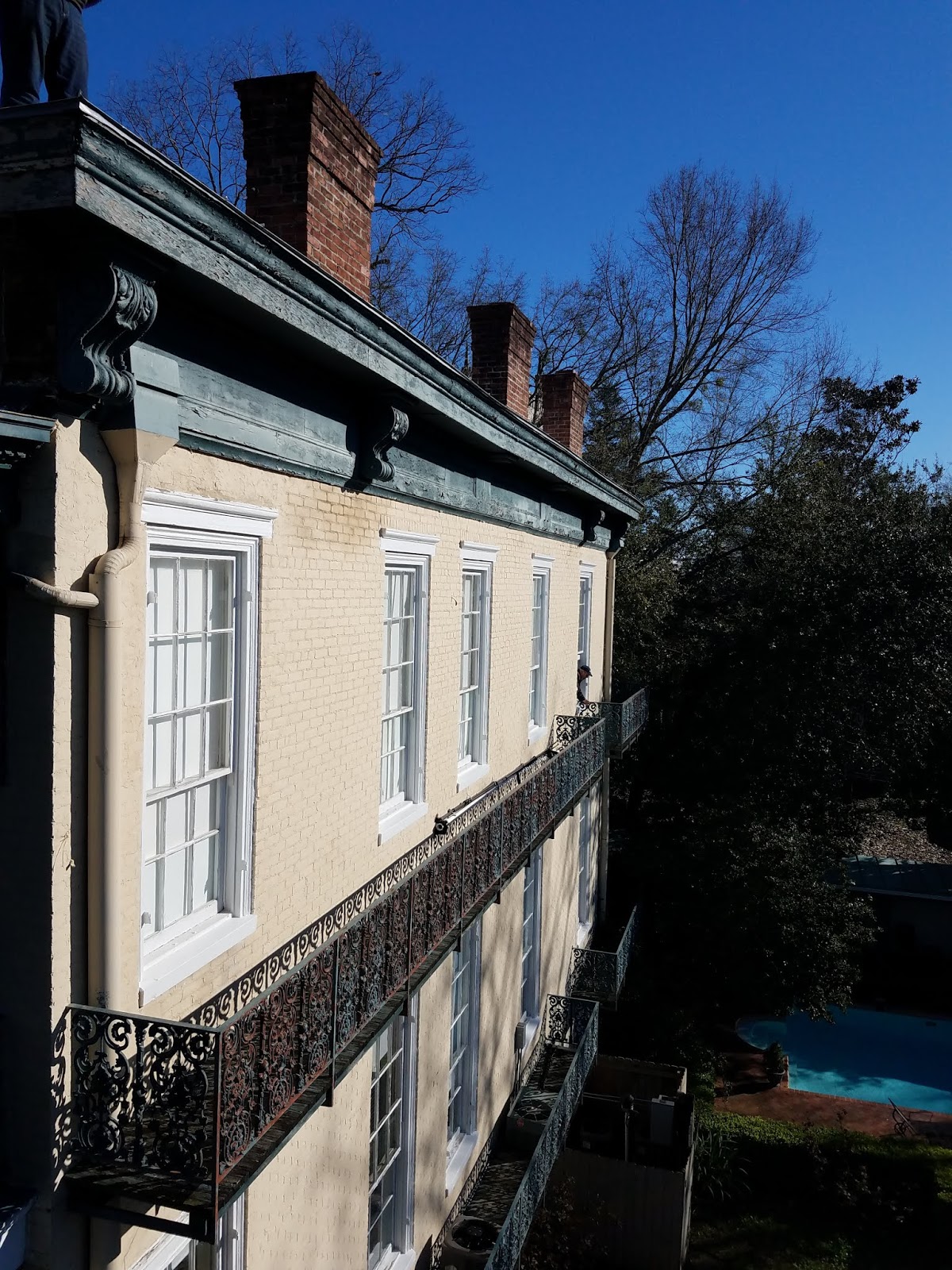
The project is interesting.  A antebellum mansion here in Vicksburg has honeybees in a corner of the building.  Maybe two corners.  I went to take a look, and was more than just a little shocked.  The bees had built their comb on the outside of the building.

Not normal beehavior.

Standing on the ground, 45 feet below, it was hard to fathom what was going on.  The bees had clearly outgrown the space that they had inside, and had continued to build on the outside.  But how....what... why?

And how was I going to get up there?

A narrow balcony hangs off the side of the mansion, directly underneath. I climbed out the window and onto the balcony, trying to get a better idea of how to access the colony.

An extension ladder would be precariously tippy, if the base is not far enough from the roofline. And it hard to get a ladder that can reach 45' in the air that fits in the back yard of the home.  Next stop was the balcony.  From the balcony, you can reach... maybe.  But my 10' step ladder would be a little wide to fit on the narrow balcony.  Maybe doable, maybe not.

Roof access is dicey.  The overhang gives a view of the bees, but I was literally hanging over the edge to take this picture.
To-the-side view.  Don't look down.
There is certainly no way to reach under from above, and completely clear out the comb. Worse still, you can't see well enough to know whether the bees are coming out of a different location, or whether you've gotten them all.

A second visit to the hive, later in the day, helped confirm some things that I had suspected, and got clarity on others.

The original hive, as best I can tell, had formed inside the architectural feature at the corner of the roof line (cornice?  eave bracket?) and the bees had quickly run out of room inside.  So at some point last year, they expanded outwards.  Way outwards.

Right now, the bees have removed most of the honey as they have overwintered, so the comb is empty and dry.  Their numbers are starting to recover, as the queen starts her spring laying.  The worker bees are getting pollen from somewhere... which means protein for the babies.  All of which is basically indicating that they are about to have a population explosion.

So it is time to get them into some new, rent-free digs.

Harley Caldwell, who owns the bee-and-bee, listened as I made my offer.  There are almost certainly two hives - one on either side of the building.  Same spot, opposite corners, almost equally inaccessible. I put it to her that there were essentially two options for removal: a) I could anchor a ladder to the balcony and the chimney, and scale the heights, or b) she could rent a lift.  My price went WAY down if she rented the lift.  But not enough to make the overall project cheaper for her.

Excuse me, General.  May I bum a lift?
Even though it would be more expensive for her to do it that way, she agreed that renting a lift was the way to go.
She is looking into the details of renting the lift for me.  Meanwhile, I am counting my boxes and frames.  Going through checklists to make sure that my tools are ready, and clean, and in good repair.  That my suit only has holes where it is supposed to.  And that I am ready, and that I have figured out what I need to do to prepare another home for another hive.

Maybe two.

Tuesday, February 5, 2019

The Flowers Appear on the Earth - Honeybee edition

With bated breath, I opened my hives this weekend.  Saturday was a warmer day for us, with temperatures in the mid-60s.  I watched the bees come and go from each of the three hives that had survived last summer and fall, and they were carrying loads of pollen into their homes.  My girls were busy.

So I read a lot about honeybees.  It turns out, though, that my reading material is the honeybee equivalent of Web-MD.  Every single article tells me that my hive is going to die, and that it is going to happen next week, regardless of symptoms.  Bees flying around?  The hive is gonna die.  Bees not flying?  Hive is already dead.  Pollen being carried in?  This early, it is probably coming from Carolina Jessamine flowers, which kills bees.  No pollen?  Death by starvation is imminent.

The sky is falling! The sky is falling!

My worry last week was that they would run out of honey stores before the flowers really started blooming. I have been reading all kinds of stories about bees that were active going into the last cold snap, and ran out of food.  Essentially, during the winter, the bees just consume, since there is nothing to replenish their stores.  Not exactly like they can head to the local Bi-Lo grocery and stock up.  The bees have to wait for flowers to pop.

So a hive can literally starve to death, even after the worst of the winter is over.

First warm day that came, I HAD to see what my girls were doing.  I needed to see three things:

  1. Are the girls bringing in pollen - to fill their need for protein?  I already knew they were.
  2. Do they have remaining honey stores, to tide them over for carbo-loading until the flowers start blooming?  This was my real worry.
  3. Is the queen laying?  If she is reticent because she is trying to make the stores last until it is warmer, she might not have enough bees for the hive to survive when it gets warmer.
Short answer, my bees are OK.  On all three counts.

Traditional guidance is to leave honey on the hive the first year.  While your bees are establishing themselves, they need to keep all the honey so that you have a healthy hive to survive the winter.  The guidance kinda falls under the rubric of 'natural is best', and is not without its critics.  My mentor explained it to me: honey sells for $7.50 per pound.  Sugar sells for $0.33 per pound.  For me, he said, it is purely an economic decision. I will ALWAYS harvest any honey I can get, and feed the girls through the winter.

I believed him.  But I did not have enough confidence to follow through.  I joked that I was going to be leaving the honey in the hive the first year, just taking enough to let the girls know that their rent would eventually come due.  But after a year of rent-free living, I explained, I am going to harvest.

All the same, all winter I wondered whether it would be enough.

So the great reveal: when I opened the hives, all three hives had remaining honey stores.  I also got to see new stores being created, with uncapped honey in one box. Not a LOT of honey remaining - the flowers need to start blooming in earnest soon, so that my girls will be OK.  But there is enough, for now.

I did not specifically spot any of the three queens, but the evidence of what they were doing was clear.  In each box, there were between three and five frames with good brood patterns.  My three queens - Maggie, Isabella, and Lady Xoc - are all laying well.  

Even boys!  Lady Xoc laid a section full of male bees, which means she is ramping up genetic markers for the next generation.  (I might be a little happier if she was investing more in the girls, but if she is looking forward, I can, too). 

As the weather warms up more, I anticipate a spike - more eggs and more larvae and more activity, as everybody gets sent out to bring in more honey.

The only down side of the news was that small hive beetles were EVERYWHERE.  I have gone from being horrified at the presence of beetles to accepting them as a part of my hives.  But they still bother me (I wrote, then erased, 'they still bug me').  The truth of the beetles is much the same as the mites: killing a bug on a bug without killing the host bug is difficult.  

Somebody long ago explained that you don't use Beelzebub to cast out demons.  Most of the time, I feel like that is what I am facing.

I have a bag of diatomaceous earth, and once the ground gets dry, I will spread it around the hives so that the beetle larvae will crawl across the stuff and turn into larva jerky.  I have to be careful not to get it anywhere the bees will crawl - after all, I don't need honeybee jerky, as well.

Regardless, the outcome of the winter is solid good news. 

Finally.... I am starting to prepare for more.  New boxes, cleaning out old boxes, and spreading the word that I am available to catch swarms and remove bees.  I got some business cards made, to help spread the word.

A young friend of mine knows that I love bees, and he included a drawing of a bee in a recent card, which I have scanned and incorporated into my cards.  


Thursday, July 12, 2018

Trap Out!

It was time.

I have been putting off the job at the Vicksburg Auditorium for a while.  Partly because of the nature of the job.  Partly because the removal from the other side of the building (yeah, they had TWO hives) had not gone as I wanted it to (the bees moved inside the building, and made a mess, in a lot of ways).  And partly because of the height of the work, combined with a shaky ladder and NO place to grab hold.  

The job, as before, requires me to remove the bees.  From the inside of the auditorium, there is no way to get to the bees - no opening and no access to the interior of the wall.  From the outside, there was also no way to get to the bees - it is solid brick with a small hole.  But the bees need to be gone.  The city has planned a renovation job on the building next month that will put people in contact with the bees, and it is necessary to get the bees out before they begin.  

And so while I did other jobs in the area, I pondered the proper way to approach this job was.  I read.  I asked.  I talked it through.  And finally it was time.  I could not wait any longer to get started.

The idea behind a trap-out is to get the bees out of a wall that you cannot access any other way.  Part 1 of the trap-out is to create a one-way door so that the bees can leave, but not return.  The bees leave the hive to forage, and then can't get back in, and start looking for somewhere to be.  They end up congregating in the closest available space. 

That is where Part 2 comes in.  In Part 2, the beekeeper places a box nearby that the escaped bees can use as a new home.  Make it attractive, make it nice, and you can eventually evict all the bees from their current home, and they will be in the new mobile apartment that you can then move to a safe location (like my backyard).

There are some problems.  Problem #1:  The queen does not like to come out.  This is a big problem, because the queen lays a LOT of eggs every day.  She lays up to 2,000 eggs every day, which means that within the next few weeks, there are up to 42,000 bees in process.  As many as you draw out of the hive, she is going to replace them just as fast.  So the process can take a while.

Eventually, the nurse bees run through all of their honey stores, and they, as their predecessors did, leave to forage.  The queen only remains inside, unwilling to leave.

Problem #2: without the queen, the workers will bring honey and pollen into their new 'apartment', but they won't lay eggs.  You need a queen for that.  So the only way to proceed is to give the inhabitants of the new apartment what they need.  

To take care of problem #2, I opened a hive at the house and pulled out two frames.  One of the frames had eggs, larvae and capped brood, as well as a queen cell (the bees had prepared a queen, just in case).  The other frame had honey.  I put both frames in a 'nuc box' with three empty frames to give the new inmates neighbors a 'partially furnished apartment' - a little bit of a head start on increasing numbers.  And the right smell.

Now all I had to do was to install the art project.
Step 1.  Anchor the box.  Kathe and I had discussed it together, and ended up deciding that the best approach to anchoring a box to a flat brick wall was to throw an escape ladder over the top of the wall, and attach it to that.  So I put the 75-foot aluminum stepladder against the wall, and started the climb, with each aluminum step compressing below me precariously.  At the top, I grabbed on to the top of the wall and held on for dear life, while I tried to 'maneuver' the escape ladder into place without sending the 'man-over'.

Following the successful installation of the ladder, I climbed back down to get the next piece of the puzzle - the straps.  Because I am planning to leave these in place for a couple of months, I used tie-down straps to anchor the box to the ladder. I climbed back up, and attached them - with only one precarious wobble in the process.  That wobble did it - at that exact moment, I made a decision, and stated it out loud for nobody to hear.

"If anything starts to slip, I am letting it fall.  It is all replaceable.  NO heroic saves."  

Step 2.  Next, I needed to place the box in the strap loops. The box, while not heavy, was a little awkward and not well centered, and climbing the ladder with it was a challenge.  But with slow, steady motions, I got in place, grabbed the top rung of the ladder with an elbowlock deathgrip and tried to slide the straps over the box.  I got them in place, but they were loose, and I started to cinch them up.  

First one side.

Then the other. 

Then back again.

One of the straps overlapped, and I was about to get caught in a bind, so I switched hands and....

26 feet, end over end tumble.

No heroic saves.

Before I descended the ladder (no point in rushing) I adjusted the straps.  My wife suggested that she could go and get me some duct tape (why don't I have duct tape?) and drove off as soon as I was safely on the ground.  I picked up the pieces of the box and frames and put them back together.

Honey everywhere.  I can't tell how badly the brood are damaged, but I suspect none of them will remain viable.  And the box itself is a mess.

But duct tape fixes everything, so humpty dumpty got patched and taken back to the top of the ladder, where he was reattached to the escape ladder.  As I started to descend, I realized that the hole was facing the wrong way - away from the opening.

Ah, well.  The bees will find the opening or they won't.

I then moved to the final step.  Setting the trap.  

The idea for the trap is that the bees will come out of a cone over the entrance, but will not find their way back in.  And if there are two cones, one over top of the other, it will be twice as unlikely that they will find their way back in.  So I sealed up the entire hole, with one opening left open, with expanding foam sealer. Once complete, I set the smaller of the cones, made of screen wire, over the entrance and held it in place for the sealer to set. 

Then repeated for the outer cone, made of 18" hardware cloth.

The process took forever, during which time I was on the top of the ladder, surrounded by (surprisingly passive) bees, clad in multiple layers of a bee suit on a hot July day at noon.

When I released the cone, and it stayed in place, I hopped down the ladder and stepped back to observe.  The bees were emerging, and congregating around the entrance.  But it is too soon to see if they are able to get back in.  I will have to check back pretty regularly to see what is happening.

**Update 8 July - I have been monitoring the bees for the past few days, and there does not seem to be any activity on the new apartment.  And more importantly, perhaps, there does not seem to be a large cluster of bees on the exterior of the cone.  I suspect that they have figured a way around the cone, and I will need to re-seal.

When I do (scheduled for Thursday), I will see if I can't take more pics.  And I will replace the box.