Showing posts with label angry. Show all posts

Monday, July 1, 2019

Reputation

Sometimes, it is a good thing to be known for your work.  When I was first trying to get into beekeeping, I talked to anyone I could find, trying to get the word out that I would pick up swarms and re-home them. I gave out my phone number, I made up cards and handed them out, I talked to officials and wrote blog entries and tried everything I could.

My phone insisted on not ringing.

As I have done more jobs, I have had word of mouth spread a little.  More people know that I remove bees from houses, as people who have had bees removed start to tell others.  It is a slow process, but one removal at a time, the word gets out.

Sometimes, it is a good thing to be known for your work.  And then, there are the times that you build a reputation without meaning to.

I was in a meeting today with some folks from the Vicksburg District, whom I have known by reputation, but had never met.  We are talking through the different parts of the water resource problem they are trying to solve, and we get to the end of the conversation.

I casually ask if he has a side hustle as a pest control guy.

He was.  Is no longer.

Someone else brings up that as long as he doesn't spray the bees, I will be happy.  They explain that I keep bees.

(Side note - I have a self-imposed rule that I am no longer allowed to provide unsolicited bee facts - my colleagues have been patient so far, but there is only so much listening-to-the-five-year-old-reciting-dinosaur-facts that should ever be allowed in the workplace.  I have, therefore, given myself a bit of a stick...)

Now that I have been prompted, I start to explain.  And we talk about bees for a while - he was a hobbiest beekeeper and enjoyed the process...   and sudden-like, Johnny leans back in his chair a little and says,

"You know, it was the craziest thing.  I live over in Belle Meade (my neighborhood), and one day I was out in my yard and I saw a guy in a truck in a bee suit."

There was no way to change the topic of conversation at this point.  And there was no way that I was going to get out of this story unscathed.  I knew the event he was referring to before he told the story.

"All of a sudden, the guy jumps out of his truck and starts swinging his arms around, swatting at bees.  It was the dangdest thing.  After a while, he had shucked the suit off, slung it in the bed of the truck, hopped in the cab and took off."

All of my co-workers were staring directly at me.  I avoided eye contact through the whole story.

Finally, my shoulders slumped ever so slightly. "It was me."

That day, I had opened my most successful hive, with the intent of stealing a single frame of brood to help out a struggling hive down the road. The girls were in a bad mood that afternoon, and no sooner had I opened the hive than they boiled out, intent on my destruction.

It just so happened that I had not done a full inspection of my gear before suiting up to rob the hive.  And I had failed to notice a small tear in the mesh covering my face.  The boiling-mad bees stung my unprotected hands a number of times, and I take my frame of brood and flee.  They follow with the fury of a toy-deprived two-year-old, screaming at me and hitting any soft spot they could.

I brush as many off as I could, and I hop in the truck.  Too many bees still occupy my space, and they are still mad.  I have no opportunity to unmask, so I start driving, window cracked, and the bees are STILL furious.  Still intent on our mutually assured destruction.

A block down the road, a bunch of them have worked their way through the slit in my veil, and start congregating on my face.  Hitting me, sitting on me, pointy side down. Every one of them taking great delight in the pain that they can inflict.  I took a few stings in stride.  I never think of it as the fault of the bee:  I was too rushed;  I was clumsy;  I moved them into a place they didn't want to be.

But these girls?  These girls were hot.  And they hunted me down, and made me pay.

The sixth sting on my face convinced me that whatever it was I was hoping for was not going to happen.  They were not going to calm down.  They were not going to leave me alone.  They were not going to fly peacefully out of the window.  I slammed on the brakes in the middle of the intersection, and jumped out of the truck.  It was at this point that I was observed by Johnny, flailing and swatting and screaming curses to the sky.

In the words of Mark Twain, Let us draw the curtain of charity over the rest of this scene.

Years I have spent, trying to gain a reputation.  I have even invited coworkers to work with me, to see how a calm demeanor really makes all the difference with working with bees.  I have done careful work, making sure to clean up after every job, taking the stings in stride, learning to work with the bees, trusting the bees, understanding the bees....

Now the only mental image that anyone in my office will have of me is of a cartoon - the guy whose bully bees beat him up in his own truck.

Friday, June 7, 2019

Love on the Battlefield

The setting of the National Cemetery at the Vicksburg National Military Park is one of the most peaceful ones imaginable.  The rolling loess hillside, graves in neat rows, each section terraced to provide a continuity among the gathered dead.  Oak trees, expanded to their full canopied width.  Magnificent magnolia trees, filled with heady blossoms.  Ancient crape myrtles and ginkgoes filling in the space.

And one very large downed tree, two terraces distant from the road.

Captain Dan Harder, a friend of mine from my time in Puerto Rico, texted me just before Memorial Day.  "Was at the national cemetery this morning putting flags out; apparently they have a giant tree that fell during the storm they can't remove because it's full of honeybees."

I had a quick conversation with the Superintendent of the park, and confirmed that they were interested in having my help.

Turns out that the giant tree was really a bigger job than I was able to do solo.  Everything I have worked to date has been able to be cut through with a reciprocating saw.  This sucker was far bigger than that.  Fortunately, Aaron Matthews, a friend of mine from work, is looking to get into bees, and offered his chainsaw prowess to the task.

Chainsaw work on the fallen tree stopped where the bees began.
Recon visit didn't tell me much, other than the size of the tree and the size of the entrance.  This is where it gets interesting.  If the bees are only in the very front of the entrance, and fill a space a little bigger than a breadbox, then I don't need to have a chainsaw.  But if it extends back further, I will need the help.

I veiled and reached in to pull out some of the debris in the entrance.

The bees, not unexpectedly, were more attached to their debris than I had anticipated.  Several expressed their displeasure in a very firm manner.

Signs of aggression, check.


Who could blame them?  The opening that they had was a knothole 20' up in a tree.  Now it is basketball- sized hole at a level that any passer-by could reach in easily.  That kind of situation would put any of us on edge.

I returned a week later to try again.  By now, the numbers had increased, and they had covered over some of the external comb with propolis, and they were even more ready to take swift action than before.


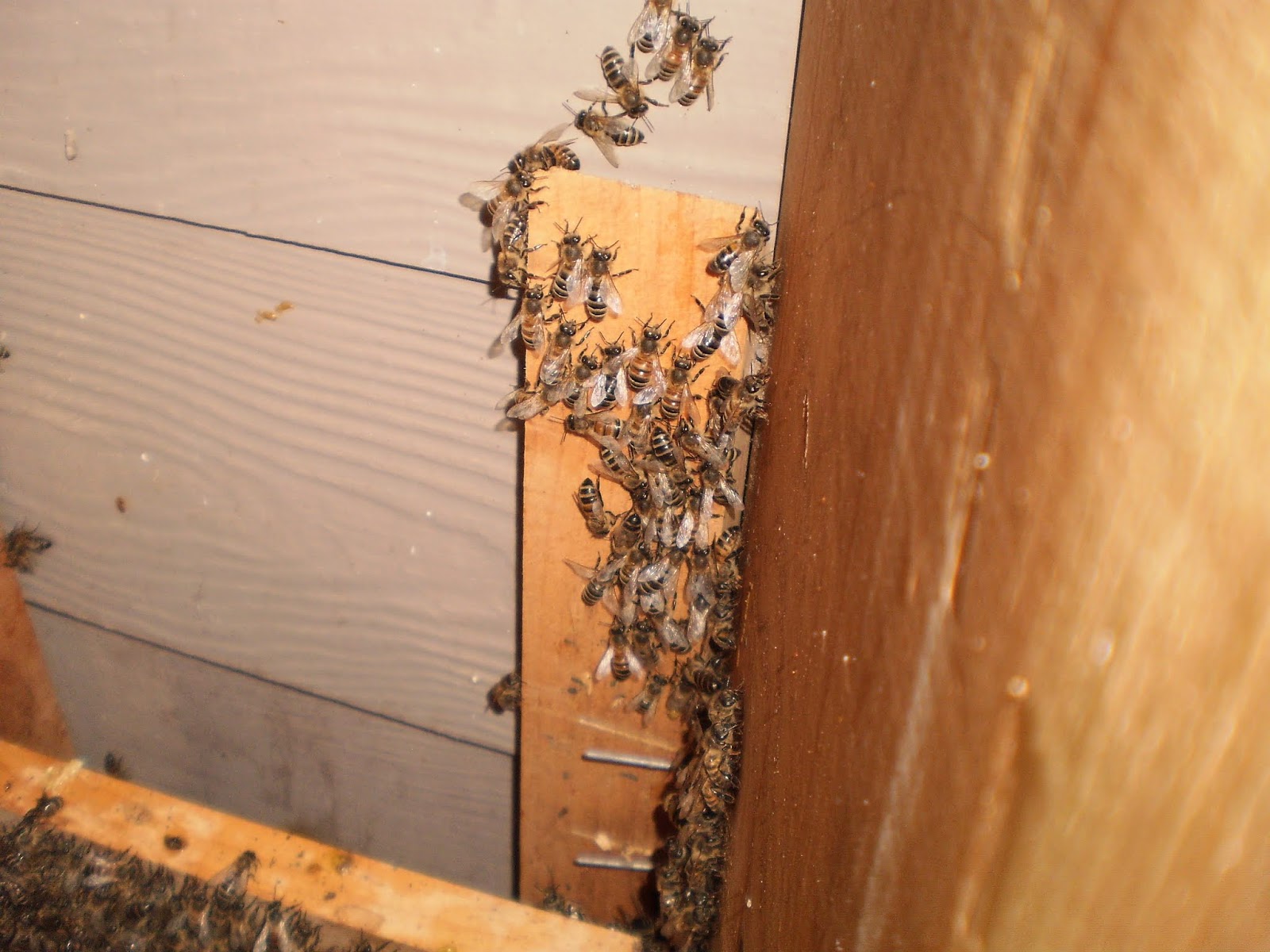
Bees covering the full entrance to the hive.
The wood has started to deteriorate, and is soft and crumbly.  They won't be able to stay here much longer anyway.  And as soon as the National Park Service can get the honeybees out, they can take away the tree and dispose of it, and straighten up the graves that were knocked around when the tree fell.

The interior of the log is covered with bees on every surface, and I did not have a way to figure out how deep it goes. 

Only one way to find out.  Reach the hand in and start cutting comb out.  And keep reaching in until there is no comb left.  The hope, of course, is that I don't run out of reach before I run out of comb. As soon as I have cut comb as far as I can reach, we have to move to using the chainsaw.

If the bees do not like people messing with the debris at the entrance to the hive, they REALLY don't appreciate solid chainsaw work.

The all-important selfie.  Obligatory.
One more visit yielded only a little more information.  The bees definitely extended further than I had originally thought.

Saturday started off cool and overcast, which meant the bees slept in, waiting for things to warm up before heading out to forage.  At 9 am, Aaron and I arrived, chainsaw and shop vac in tow. With a borrowed generator from the Military park folk (thanks for coming out, Auston!) we got started.

The initial foray into the hive was daunting. I have been chased by bees before, and I have had an entire hive mad at me before, but this was impressive.  The bees just boiled out of the hive, and enveloped both of us in a cloud of bees that overwhelmed us from the first cut of the comb.

I guess it makes sense.  The bees had been safely ensconced in a tree, safe from the elements and from predators.  I imagine that they lived a peaceful life, with no particular aggression needed to keep them safe.

Then suddenly, as Auston put it, God got mad at 'am, and suddenly they are living in a log that turned their hive 90 degrees on edge, and opened both entrances to the elements.  And to predators.

Auston told us, "Since they can't get mad at God, so they get mad at you."

And get mad, they did.

I looked down and did a quick count.  60 stingers in the back of my glove. Where I leaned forward to reach into the hive, the bees stung my cheeks through the veil.  Four times.  Another half dozen stings hit my hands through my double-thick leather gloves as I reached in.

For an hour, I cut away at inaccessible comb while Aaron helped keep the smoker fueled and fired up to help calm the horde.

Before the log fell, the bees had drawn comb vertically in the hollow of the trunk.  When it fell, that comb is now horizontal - not the bees' preferred position. So they sucked the nectar out, abandoned the use of those parts of the comb, and began drawing comb from the top of the log, and connecting it to the now unused comb stacked at the bottom.
Cross combing
Even so, they maintained the spacing that they needed to do basic housekeeping. So everything is stable, but also built at cross angles to everything else.  Cross angles make it impossible to remove comb cleanly.

And the bees that are now defending the wide open entrance are VERY defensive.


After the first cuts were completed, we pulled enough brood comb to start the bees in their new digs.  Once the box was filled up, we transferred all the comb to Aaron's new bee yard, and ran the vacuum for the first (of three) times, collecting some 15,000 bees in the process.  All of whom got transferred to their new hive.

Very quickly, I ran out of space to work, and Aaron started up the chainsaw.  The top entrance of the hive was quickly liberated, and the entrance in the base of the log widened, so that I could get at more of the comb.

Video taken with a potato....

Twice more, we smoked the bees to the entrance, and twice more, we removed the bees with the vacuum, transferring them to the new hive.

Final step was to feed the honey back to the bees, so they could use it to build the comb in their new box.

I used my newly-acquired Square (TM), and received the agreed-upon funds from the National Park Service. (#SquareOne, #contest).  The transaction was very smooth, and completed the full project perfectly. 

Bees defending high ground
In the final analysis, this was the most aggressive hive I have dealt with.  Possibly also the most bees.  Normally, once I get the entire area open, the bees will settle down and I can work more comfortably, in long shirt and pants with a veil.  These guys would have none of that.  I wore full gear the entire time.... only working without gloves towards the end.  Even then, the bees were feisty.

But I hope that gives them a fighting chance, as well.  We salvaged as much of the cross-combed brood as we could, with which they can raise more bees.  But even so, it might not be enough.    I'll be talking to some friends about installing a queen (we never spotted her) to help the hive establish.  But we'll give the 40,000 relocated bees a few days to build comb and make the hive their home.


And when we do, I'll update you all on the progress.


UPDATE:
"There are 3 bees left."

That was the message I got last night, four days after we removed the hive.  The bees absconded. A large number of them apparently died, within a couple of days of removal, and the bodies piled up.  And the remaining bees took off, leaving an empty hive.

I am going to get a handle on the relocation piece of this business one of these days.   It still seems like such a hit-or miss strategy I employ.  And sometimes it works.  Other times, not.  I usually come up with an after-the-fact explanation (too cold, too slow to move them, too long in the heat, induced robbing).  But the truth is, I am not always sure I know.  It is guesswork.

I need to guess better.

Sunday, March 3, 2019

Taking, Pried In my Work, with a Stinging Postscript

Back at it.

(If you just want to read about me getting stung repeatedly, skip to that part of the story at the bottom of the entry, under follow-up:)

I was determined today to remove the eave bracket and get at the honeybees inside.  Suited up, grabbed the crowbar, and started crowbarring.

The first part of the removal I attacked was the molding over the top.  It came out pretty easily, even with the 150-year-old cut nails holding it in place.  This action did not expose any bees to the elements, though.  Above the eave bracket was just a wood block, and above the block, open space.  And a lot of cobwebbing.

Next I worked on prying the bracket loose from the wall.  The more I pried, though, the more that it seemed that everything was giving way, while the eave bracket was holding firm.

One other thing occurred to me as I was tugging at it.  As I twisted and pried, the force of my effort was vectored away from me. Simple physics (PhuFy!). Problem is, there is nothing that could prevent it from breaking loose and falling over the edge, making it into a heavy metal block filled with lots of unhappy bees, unprepared to meet the ground with intense deceleration trauma.  In the process, the eave bracket, a lovely piece of 150-year-old cast iron, would meet an unhappy demise, as well.

Long journey home.
I had already requested that the people parked directly beneath the edge please move their cars.  But I really did not want to lose either bees or bracket.


So I tied off some string to the bracket, and tied it to another bracket, 15 feet away.  That seemed crazy flimsy, so I looked around for something else.  Finally went down to the truck (my fifth trip down 4 flights of stairs) and got a tie-down strap, and tied it off to the same adjacent bracket.

Tightened it down.

By this time, the bees are getting a little curious.  It is a cool day - temperatures in the high 40s - and they are reluctant to venture too far from the warm hive.

But as I started to pry... they got more excited.

I alternated prying and ratcheting, until I started to see it give.  Just a little to start off with, and then increasingly as I pried more.  Finally, it gave way, and dropped.  75 pounds of bees and cast iron and sand (Wait... sand??) and comb all fell and landed at my feet.  Removal with a bang.

It did not go over the edge.  Win.

The bees, however, did not consider this a win.  In fact, they considered it a very upsetting loss, and began to let me know about it in no uncertain terms.


I took the comb out, piece by piece, salvaging whatever I could so I could place it in the box that I had prepared for it.  By this point the bees had calmed down, as it was pretty chilly. Their focus was on getting as much of the honey out as they can, and balling up around the queen.

Who was elusive as she could be. Queen of hide-and-seek.

The sand inside was a bit of a mystery at first.  But when I looked at the inside of the eave bracket, there was a series of clay molded pieces inside - the work of dirt daubers.  Apparently, when the bees took over, they ousted the dirt daubers, and just built on top of the old mud... some of which dissolved and collected inside as a sand bath.

After cutting all the comb out, I took the eave bracket and placed it on top of the empty box, that had new comb interspersed in it.  With both cold and wet weather coming, I am skeptical of whether it will be good for the girls.  But I hold out some hope.

There was a little bit of honey remaining, and the girls had just started to put together some new stores after a long winter.  Since I removed those pieces, I will need to feed them to keep them going until they can do it on their own.

There is another hive at Duff Green Mansion.  In a couple of weeks, I will be able to get it, using a lift.  But from this hive, I was able to find out the piece of information that I needed to make that next one go smoothly.

There is a metal brace underneath the eave bracket that supports it.  This was the piece of information that I needed.  The bracket beneath holds the bracket in place, and once it is removed, the bracket comes loose.

My frustration in last week's attempt at this was that I had removed the bolts, but had not seen the brace.  So prying did me no good.  This time, brute force and ignorance won, but it also gave me the information I needed.  By removing the bolts, and removing the screws that hold the brace in place, I can easily remove it.

Maybe not easily hold it.  But definitely remove it.

Follow-up:

The night after removing the eave bracket and encouraging the bees to enter the box, we got rain.  Cold rain.  It was bad, and I was pretty sure that any bees that survived were going to be in bad shape.

So I decided to rob my healthy hive of one frame of nectar very quickly, so as not to disturb them too much.  Quick in, quick out, nobody will be too upset.

Wrong.  Very wrong.

Usually, when I am doing things with minimal impact, I'll put on a veil and maybe a long sleeve shirt. And sometimes I'll work without smoke.  This time, I took time to suit up and got my smoke going first.  Every precaution.

Those girls boiled out of the hive and started working on my suit, sacrificing themselves by injecting venom into the cloth with reckless abandon.

Eventually, one or two of them found a crease, and injected a little venom into a leg.  And an arm.  Then a shoulder.  Still they came boiling out.  Smoke did not deter them.

Then I felt a sting on my neck. I glanced down to see if I had managed to leave a gap in the zipper-velcro seal at my throat.  Nope.  But there she was, inside with me.  Still trying with every bit of energy she had to hurt, rip, damage the intruder to HER hive.

Then another appeared.  Walking across my throat, with similar intent.

Bees by the hundreds, covering mask.  Covering my jacket.  Covering every surface.  I cut my work very short, and left with the first piece of hardware I could pry free, closed up the box as quickly as I could, and fled.

They followed, grabbing on and stinging with evil glee.  More arm stings, leg stings, and five more bees in my bonnet.  (That expression was never more apt.) I dropped the frame with a slight amount of nectar into the back of the truck, and went back to rescue my smoker and tools.  When I did, the girls came back after me with renewed vengeance.

I had heard of hot hives, but this was the hottest I had ever experienced.  They were MAD.  Clearly, these girls had spent WAY too much time playing first person shooter games.  They didn't even care that it was just one bullet that they carried.

I shook off as many as I could, and got into my truck, still suited up, with bees all over me.  I cracked the window (weird fun fact: bees will leave if the window is cracked, but not if it is wide open), and a few bees made it out.

And then, one block down the road, the bees inside my suit all decided to get me at once.

I pulled over, jumped out, and stripped my suit, shaking off as many bees as I could.  Still they came after me.  One on my scalp.  Another at my throat.  And my eyebrow.  Now that my arms were bare, they were looking lasciviously at long expanses of exposed flesh.  Looking to do violence.  It was then that I noticed a hole in the mesh in front of my face.

Note to self: check mesh BEFORE getting into an altercation with defensive bees.  Not during, nor after.

I got back in the truck.

The whole trip back to Duff Green, bees flew at me while I was driving. I checked twice before going through the house, because I really didn't need additional angry bees introduced into the Bed and Breakfast.  Not good for business (either theirs or mine).

When I got up to the top, it looked like the bees had not made it.  I turned the eave bracket over, and there were no bees in the box.  Over at the wall, there were a pile of dead bees still attached to one another where the bracket had come down.

And so I turned the bracket over, and out tumbled a slightly damp mass of sad, unhappy bees.  But they were alive.  And the first girl to show up, right on the top, was Mary Lake, queen bee of Duff Mansion herself.  I grabbed a queen clip, trapped her quickly,  and dumped her in the box.

A few minutes later, I had swept as many live bees into the box as I could, and placed the stolen - and dearly paid for - frame of nectar into the box, and closed the lid.

Cleanup will come another day.

On the way home, more bees warmed up.  And they, too, stung me.

So I am writing up my results with one eye half swollen shut, and a silly grin on my face.  Those girls are going to do OK.  Lady Xoc is laying like crazy, and making some crazy bees to defend her turf.

Sunday, July 1, 2018

Vacuuming the Bees

You meet with the person in charge of the auditorium, and are immediately put at ease by his easygoing demeanor and easy smile.  After showing you how to find the ladder, Mr. Artiss opens the door to let you hook up the vacuum.  You have coordinated with a co-worker to meet you and hold the ladder - Lee Robinson is fearless, and ends up being a perfect choice.

Hook up the vacuum to the bucket, with the mesh bag inside the bucket to catch the bees, hook up the other hose to the lid, and cinch the shopvac tight against the 7' ladder, and you are ready to go. You started at dusk, when most of the bees would be returning from the field.

I don't know if you know this, but you are VERY much afraid of heights.  And the 30' ladder provided by the City of Vicksburg is pretty rickety. But in the face of such predicaments, you forge ahead.  Because you have chutzpah.

Lee holds onto the ladder, which is wedged between the tree and the building.  And you begin the climb, squeezing between limbs and the brick wall, up three stories.  After tying off the bucket to the ladder, as high as it will reach, you grasp the hose, and give the signal to Lee, who turns on the vacuum.

And the bees begin to disappear down the gullet of the bee vac, making a satisfying sound as each gets sucked backwards.  (Your hose, however, creates a harmonic, resulting in a band-saw like scream that is painful on the ears.  Note to self: the next time you do this, you should probably bring some headphones).

After five satisfying minutes of watching bees get sucked into the machine, you realize you are leaning further and further in towards the entrance to the hive.

Oh, no.  Your vacuum doesn't suck.  Or, depending on your perspective, it does.

So you descend the ladder, carrying the bucket of bees to the ground.  And you transfer them to the spare bucket, an act that makes Lee hightail it away from your spot, as the bees emerge QUITE unhappy with you as a result of their journey.

Now that the bucket is cleared of bees, you ascend, and discover that the vacuum still sucks.  Or, rather, that it does not suck.

Darkness is coming.  You do not have illumination.  What do you do?

Keep working.  The hole won't change its location, so you can easily use your now-failing vacuum to not suck up angry bees in the dark while on top of a 30' ladder.  Click here.

Seal up all holes except for the one you are drawing from, and plan to try again tomorrow. Click here.


Cone Trap - Hardware Cloth

It makes sense.  If bees can get back into the cone the way that they got out of it, you need to change the cone.  The pokey entrance was not enough to dissuade (or you decided, like I did, to try the combination first) and you reinforce the cone with hardware cloth ($18 at the hardware store)

The concept: the outside cone gives the bees coming back in an entrance.  But at the base, they also have an exit, so they don't find the opening at the tip of the interior cone.

Note the total lack of bees
congregating around the entrance.
I am not sure how this is supposed to work.  Because it doesn't.  The bees go straight through the cone on the outside, and climb back in the cone on the inside.  The cone-within-a-cone serves no purpose.  Meanwhile, your box of bees, with a frame of brood, is getting no attention from the bees you are trying to trap.  So they are very actively NOT working to raise a new queen, because they already have a hive, and a queen, thank you very much.

So you have wasted a week.  You have wasted another can of expanding foam sealer ($7).  You have killed off all of the eggs in the frame you stole from the other hive. (What a waste.  Seriously.) 

So since the holes are too big, and there is no way to retro-fit it, you will start again.  Cutting away the whole mess, you pull apart the pieces you have used, keeping small cones and long cones and discarding the pieces of foam. (Meanwhile, the angel on your right shoulder begins to complain that you are letting pieces of foam fall without picking them up.  So you stop and do that...)

You look for something to use to ensure that your form gets held, and that can be attached to the wall.

OK.  Tea balls.  Why not?


You cut a hole in half of the tea strainer.  And you use it, attaching it to the side of the building.  The bees immediately start emerging, and they don't come back inside.  (Well, at least for a day).

When they do, you take the other cone, salvaged from the previous, and cement it into place using the last of your second can of expanding foam sealer.

Are you getting tired of this?  Yeah.  Well, let's see how your box is doing.

I forget.  Did you...

Attach the box using ratchet tie-down straps?  Click here.

or did you attach the box using bungee cords?  Click here.

A New Day

It is a bright, new day, and you have it all figured out.

Overnight, you worried the idea over and over.  And finally decided on a course of action.  You are going to swap out your ShopVac for the one your wife has.  Hers is more powerful, and won't lose suction so easily.  You have installed the bees from last night's efforts into a new box.  There is a bit of unhappiness with the bees there, and a lot of casualties involved in the effort, but without a nearby hive to migrate into, they are mostly staying in the box.

After sealing all except the entrance you want
to vacuum, the bees begin to congregate
And, again at dusk,  you return to the scene of the crime.

7' ladder, up.  New, more powerful ShopVac plugged in, and secured.  Clean mesh bag in the retrieval bucket, connected to the vac with a hose, and secured on the tall ladder.  Hose connected to the top of the bucket.

You climb the ladder, and give Lee a wave.  He fires up the vacuum.

And, suddenly remembering the importance of the headphones, you give him the signal and descend.

Removing the gear, you put the headphones on, and put the veil and the jacket back on, and climb the ladder again.  Vacuum on, the bees start to get sucked into the bucket.  It is working.  Powerful vac FTW!

And five minutes later, with the sun dropping further on the horizon, you begin to noticing decreased suction.  Again.  Testing the hose on the back of your glove you confirm that your new vacuum sucks, as well.

Aw, crapola.

As before, you descend with the bucket-o-bees, transfer them to the spare bucket, re-climb the ladder and start it up again, and the vacuum declines to pick up any more bees.  At this point you are:
  • High up an unstable ladder, with
  • Angry bees all around, with
  • A useless tool in your hand.
You are at a crossroads.  You are expected to complete the task in short order.  You want to get paid, but more than that, you want to complete the job. Which means, get the bees away from the people.  Into a new home is preferable, but if not, you are paid to remove the bees.

You have a choice.  You can:


Aluminum Screen

OK, you have decided to go with an aluminum screen cone.  Good call.  Aluminum screen is hardy, weather resistant, and a little bit pokey - so you can keep the bees from reentering.  So now you are off to the local hardware store to buy an $8 roll - the smallest available - of aluminum screen wire.  Pretty easy, and lots of replacement for when the first cone doesn't work.


You roll the cone as tight as possible, so that the bees can only get out one at a time from the tip of the cone.  You fray the edge, so that all the pokey edges are pointing outward, making it harder for bees to return. And you seal up all of the other holes with expanding foam sealer, so that the bees have to go through the cone to emerge.  The expanding foam sealer is goopy and sloppy, but after about ten minutes on the ladder (surrounded by very anxious bees), you can let go of the cone and it stays where it is.  A little bit extra foam around the base to ensure that all of the holes are sealed up, and you are good to go.

Now it is time to place your trap box.

Your concept: Take a small box, of a shape and size that will be attractive to a swarm of newly homeless bees, and give them a place to live.  Put frames in there, so that they can build comb, store nectar and pollen, and arrange living space.  And perhaps most importantly, steal a frame of brood with eggs and ready-to-emerge bees, from another hive, and put it in.

The bees will take one of the eggs, perhaps more, and turn them into queens.  At least, that is the theory.  And then you hang your box.

This is not a simple task.  You can't drill into the side of the building - it is historic brick.  Besides being hard to do, it is also a structure of cultural significance, and randomly drilling holes is frowned upon.

So you come up with two solutions: a) you can tie the box off to an anchor of some sort (you decide on a window weight from an old fashioned window - $5 at the antique store) or b) you can buy an escape ladder ($35 from your hardware store), and attach the box to it. (You decided on the escape ladder.)

You are using the cardboard box you got when you bought your bees, and there are three of them, so you are good on that front.  Now it is just a matter of anchoring it to the hanging ladder.  Do you:

Attach it using tie-down straps?  Click here,

or,

Attach it using bungee cords? Click here.


Keep Working - Night-Time Edition

You really aren't too bright, are you?

Bees stung you through the suit, you flailed in response, dropping the vacuum and falling off the ladder.  As you fell, you dislodged the bucket with the bees, which fell on top of you.

Your screams could be heard for miles.

Lee Robinson, who advised you not to continue, tried to catch you, but missed.  And once the bees broke loose, he ran for his life.  And then called 9-1-1 for you from a safe distance.

The emergency personnel tried to help you, but could not get past the bees.  They called a beekeeper from a nearby town to help, but by the time he arrived, you were already past saving.  Better luck next time....


Maybe the most awesome image ever. 
I need Windi Sebren to make me one. Stolen from this page.
Fortunately, Dead Beekeepers is a great name for a garage band....


(This is the only one of the blog entries in this series that does not reflect reality.  After all, Lee didn't really run away....)

Wanna try again?  Click here.

Thursday, June 14, 2018

Don't Look - Long Way Down

I extended my 20' ladder to its full length, and placed it against the front wall of Mr. Stephen Edmonson's house.  I clambered up, I stood on the top available rung, and still fell about four feet short of being able to peer into the hive.

This beehive removal was going to be tricky.

Stephen has a lovely house over in Ridgeland, about a 45 minute drive from my house, and he has bees that have infested the corner of the house. As he explained it,
Last year, we had a huge swarm of bees out in the tree right there in the front yard last year, and they just stayed there for a long time - it was just amazing.  Eventually, they moved into that spot right there. Then a couple of months ago, the AC guy got stung a couple of times in my attic, and there are a lot of dead bees up there.  So I contacted another beekeeper, who just got too busy.... and then I called you.

From the top of the ladder, I was at a better vantage point, but it was also very clear that my ladder was not going to cut it.  It was also clear that there was NOTHING to hang onto. But the bees were industriously running in and out of the hive, bringing in their groceries and doing their bit to pollinate the world.

I came back and told Stephen, "I will need to get a better ladder, but I can do it.  I will need somebody to help with this one, just because it is high, though.  But we should be able to get it out of there with little problem.  I'll send you an estimate, and we'll schedule the work."

Armed with a sturdy rental ladder from Home Depot, I returned this past Saturday to take on the job, with a friend and beekeeper Shannen Blackledge.  Even with the taller ladder, though, the drop from the top was formidable.  My auditorium job (blog post still pending) was probably higher, but at least there were some branches to hang onto while I worked. Not so here...

Every removal job I have done has been an exercise in problem solving.  How do I get to the bees, how do I open the hole enough to get them out; how do I remove them safely (both safety for me and safety for them) and how do I keep them from returning?

Finally started, I removed the molding on the face of the hive, and pried up the roofing just enough to see the extent of the comb.  And it was beautiful.  Layer after layer of beautiful, amber-colored comb. And curious bees looking back at me, without aggression or anger, just checking me out, then going back to clean up the mess I had already started to make.

That mess was about to get a whole lot worse.

Peeking inside.
I removed the shingles from the overhang (overbalancing once for a frightening moment).  And then tried to pry loose the waferboard (OSB) underneath.  The OSB extended under and through, and was tied into place from multiple directions.  After a half hour of trying to untie the Gordian knot, I got out the Sawzall, and cut through the OSB that capped the area. The comb was attached to the waferboard; removing it broke the very top of the comb off, and the delicious smell of honey permeated everything.  And the honey started to drip.

Honeycomb attached to waferboard
It dripped onto the ladder.  It dripped onto the light fixture.  I dripped onto the tarp (placed on the patio in an odd moment of foresight on my part) and onto me.  I invited Shannen to take a look from my perch on top of the ladder.  After a brief glance, her nice, clean suit was no longer either.

Then I started removing comb.  The first piece is almost always the toughest, as you have to try and remove the comb from the top, bottom, and sides, all without destroying the comb or spilling a drop of honey or pinching a bee or overbalancing.

...revealed more beneath.
This time, I successfully used a combination of bbq tongs and a long, thin jabsaw that let me cut the pieces free by sliding between the pieces of comb. What surprised me was how far back I could feel the comb.  The open space between combs extended more than 3 feet back... well beyond where I should have encountered the brick of the wall.  Oh, man, I thought.  This is going to be a MUCH bigger job than I thought.

A few more pieces of comb removed, and it was clear what had happened.  Instead of brick, there was foil-backed styrofoam board, covering an opening in the wall.  The bees had chewed through the styrofoam, and the ladies had built two combs and filled one with honey.

This was how the girls were getting into the attic. This was how the AC guy got stung.

Meanwhile, I am frantically looking for the queen.  My previous removals have not resulted in complete success, because I did not find the queen, and separate her out.  In one removal, she escaped and hid, only to return to the scene and instruct her followers to build more comb.  In another, I feel sure she got smushed by the vacuum (I have since lowered the amount of suction I use).  None has resulted in a queen that is viable.

So this time, I am on the lookout.  I extract a bee with an enormous abdomen, and am thrilled.  I have found the queen! Then I find another.  And another.

Apparently, this whole race of bees has huge distended abdomens.  And because they are coated in honey, it is hard to tell.  (Eventually, I captured her.  I think).

Finally, after dozens of trips up and down the ladder, each time carrying more brood and honey and comb down from the perch, and each time smearing more honey onto each rung of the ladder, I had hit the end of what I could reach.

There were still eight pieces of comb that needed to be removed.  And I had no real way to get to them.  The remainder were bracketed by multiple 2x4s, and closed in - completely inaccessible.  I reached in to cut the next one free, but every time I would reach to retrieve it, I would only manage to push it further away.

By this time, I had worked the site from 9:30 to mid afternoon, and I was getting tired and a little more accident prone.  I had managed to stave off a couple of slips (note to self: buy shoes with better traction) and a sickening slide of the ladder against the now-slick brick of the building (note to self: buy a ladder stabilizer) and a scary moment with the Sawzall (note to self:....um.)

Honeycomb's big, yeah, yeah, yeah...
I worked out the only solution I could come up with.  One more board was removed from the front - a small section of 2x4 that ran along the face of the opening.  Once I removed that piece, I had access to the remainder of the comb, which was very fresh, bright, new comb with pure honey inside.

All of the family - Stephen, his wife, and his four beautiful kids - all got in on the action at different points in the day.  For them, and for the passersby that stopped to ask us questions, we carved out and shared honey.

Then took the rest back with us.  (Where it now sits, in mason jars, ready for consumption....).  And finally, the removal of the comb was complete.

All (all!) that remained at this point was removal of the bees, cleaning the empty space, and relocating the bees to a new home.

It had already been a long day at this point, and it was not getting any shorter.  Shannen put another bottle of water in my hand - she had been carefully monitoring me for dehydration all day long, and fed me bottle after bottle of water.  A true life saver.

I attached my beevac to the shorter ladder and climbed up three more times to remove as many bees as I could reach.  Many would come back from the field later that evening and next day, but I managed to fill three buckets with bees, each getting set aside for placement once we got the comb moved to a new location.

I doused the entire opening with ammonia, which got the bees excited, but did not induce them to leave.  Finally, once the majority of the sticky mess had been turned into an ammonia-y mess, And most of the bees were gone, I added the poison to keep them from coming back and reoccupying the DMZ.


The final step was to get the bees installed in a new home.  I considered all my options.  The ones I favored all involved 3Bs - beer, benadryl, and bed, and leaving the bees for the next day.  But to give them the best chance at survival, I needed to get them into a new home as soon as possible.

I finally decided that I would drop them into a top-bar hive on Eddie Brook's property.  Two different removals have ended up on Eddie's doorstep, and one of the hives had completely absconded, so there was space.

I cut comb, wrapped rubber bands around the comb, and strapped the pieces on a top bar, fitting them into the box.  Then I suited up, and dumped all three buckets of bees into their new home, wishing them luck and leaving them behind. So that I could head to a place where three different Bs awaited my attention.

Reports from the field:

From Mr. Edmonson, following the removal:  On Sunday there was a huge swarm of them all around our house. Hundreds where you removed the hive. We almost couldn't go outside, they were attacking us in the front and back yard. We left after lunch on Sunday and just got back this afternoon. I looked up at the hive area, and I could see no more than 3 bees buzzing around and a lot of dead ones on the ground. So you must have gotten the queen.

And from Eddie Brooks:  There are LOTS of bees buzzing and happy around the new hive.  They look good.

Some Lessons Learned:

  • Ladder stabilizers are a must for high jobs.
  • Bring the top bar hive with you so you can tie off comb as you remove it.
  • More tupperware will always be needed.
  • Benadryl tablets might not be a bad thing to bring along. 
  • Hornet spray splatters back on you (and burns!) at close range.
  • Granola bars are a requirement.  A full meal in the middle of the day would be bad, but hunger at the end of the day is bad, too.
End result, I think this will be a success.  The bees are now no longer in the house, and a carpenter can come and do the repair work without fear of being stung.  And the bees have a new home that they can live in, with attention and care being paid to their well being.

Can't wait to see them building more comb.


Friday, May 18, 2018

Removals (x2)

"I am reading through this contract, and the way I read it, you will not replace the work that you tear out.  Am I reading that right?"

It is a fair question.  A fair thing to ask.  Mr. Victor Robinson has a tenant who was looking to have bees removed from his back porch, and I had gone over for an inspection and had discovered two separate hives - one on each level of the condo.  I had modified the contract accordingly and emailed it to him.

"Sir, I am a bee removal specialist," I explained.  "I am not a specialist in construction.  To be perfectly honest, as much as I don't want to be your carpenter, the truth is, you do not want me to be your construction specialist.  Jack-leg does not even begin to cover it."

"When Mr. Ervin did it last year, he replaced the boards and closed it up."

Sid Ervin is a legend hereabouts, and with good reason.  He did amazing work all across the state, opening up buildings with an absolute minimum of fuss, removed the bees that he could, poisoning the bees that remained, sealing up the hole, and leaving.  He earned his money; he was good at the work, and there was quite a demand.

But I had just finished a job where I drilled into plaster, and was (am) still working on a job that involved brick.  Recent experience has already shown me my limitations in a painful way.  It was a critical moment for a critical question. "If it is as simple as tacking a board back in place, I will do that.  But anything beyond that is beyond my carpentry skills."

We agreed, and I received the contract by email later that day.  And Monday, I gathered all of the items that I thought I would need and drove an hour over to Brandon Mississippi, to remove bees.

According to Charles Smith (I had a moment of panic when I was told that his name was Charles Smith, since that was also the name of my LAST job - I worried that I had gotten the name wrong on my first ever invoice....), the bees had appeared a little over a week earlier, and just completely covered the porch.  It was a very large swarm, and within a day, they had disappeared.  Into the column.

With a week's growth, I figured it was a good time to do the removal.  The bees would have had little time to build the comb, and it would not be terribly messy with only limited brood and comb.

I was wrong.  Very wrong.  Holy honeypot, the amount of work bees can do in a week when they are motivated is astounding.

Pure uncapped honey from the first step of opening the hive.
The only time I had watched bees begin to build a hive was at my house from the swarm collected from Drummond St., between the house of Launo Moore and Jill and Tony Bishop.  So I though I knew how fast the girls would build comb.

These girls swarmed just as the flowers were blooming, and there were resources.  It was also a much larger swarm, and they got busy.

I opened the top of the column, and immediately had honey to collect.  I went inside and snagged a small tupperware piece from the kitchen counter, salvaged some of the honey, and covered it for sharing.  With people, not with bees.  They can fend for themselves.

Opening the column.
Kathe had sent me on my previous removal mission with a set of barbecue tongs, and I found them enormously helpful in holding the comb in place with a minimum of damage.  My previous experience at the house in Vicksburg left me a little scarred on how much damage I had done to the brood comb, and I did not want to repeat the mistakes.  I was pleased with how they worked.  I might even use the tongs/spatula combo I have in the drawer for future removals.

The comb came out cleanly, with a minimum of fuss.  The latex gloves I wore kept tearing, and were discarded quickly, but all in all they served well.  Stings were lifted off the skin, and swelling fingers kept to a minimum (my ring mentioned in a previous entry still has not been repaired.)

Ollie, ollie, oxen free!
But I got the comb.  And the bees.  They were not happy about the situation, but that is not an expected outcome anyway.  Once I had removed the majority of the bees, I opened the side of the (square) column, and removed the rest, while providing remaining bees a chance to congregate at the central location.  I did not find the queen, but played an intense game of hide-and-seek for several hours, trying to figure out which section of the hive she was under, which board she was hiding behind, or what disguise she was wearing (I'm just a normal bee, nothing but a worker bee.....).  She also (quite cleverly) dressed up 8,000 of her closest relatives to look just like her.


Come out, come out, wherever you are...
And, yes, I am still tinkering with the vacuum.  The draw is too strong, and many of the bees are damaged in the process, so I am trying to use the beevac as infrequently as possible.

But the job is to remove the bees, so when I have removed as many as I can by other methods (singing to them, playing the fife, etc), I am pretty much left to remove them by sucking them into the vortex.  By far my greatest draw is to put comb into the bucket, and let them move to protect the comb.

Light, delicious honeycomb.
The comb was almost preternaturally bright.  This was not old comb - Charles was right that they were newly occupying the space - the comb was less than two weeks old.  And already they were drawing honey - light, sweet honey.

Once I had cleared the space up top, I moved to the lower level, where I removed the fascia board to reveal....

...more wood.

A bit anticlimactic.  I had hoped to hear the roar of unhappy bees, preparing to do battle.  Instead, I heard the thrum of bees going about their business: dehydrating nectar, stashing pollen, caring for brood.  From behind another layer of 2x6 #2 spruce.

After poking and prodding for a bit to see what could be removed, I finally succeeded in removing a horizontal piece, revealing bees back and to the side.  A very defensible position, the scout bees explained to me, as they offered to demonstrate the ways in which they were willing to make my life more difficult.

Piece by piece, standing 13' off the ground on an aluminum ladder, I removed pieces of the hive until all the new comb was gone.  Much like the other hive, these bees were a recent arrival.  Lots of new, fresh comb with both larvae and light honey ready to be capped with a wax cover, eggs, and bright pollen filling cell after cell.

After I had safely removed the comb (and, honestly, feeling a little proud about how well I was doing) I dropped back down to re-evaluate.

Not much of an opening.
Truthfully, being on a ladder, the phrase 'pride goeth before a fall' occurred to me more than once.  But everything up until this point had been pretty solid.

I grabbed the flashlight and looked into the hole.  To my surprise, an awful lot of bees looked back at me.  From very far back in the cavity.  I started reaching further back into the hole, making a bunch of bees very worried in the process, and I kept cutting comb.  But this was not bright, white, or even yellow comb.  This was old, dark comb.  There were no eggs, pollen or honey in any of these pieces.  These pieces of comb were left from last year's removal.  And maybe before that.

I was reaching to the maximum extent my arm could reach, deep into the hole.  And as much as I was extracting, there was more.  This hive had extended deep into the area between the ceiling and the floor.  And with every new patch of dark comb, more bees emerged.

I vacuumed again, and pulled out everything I could.  Finishing up with a wipe down of the entire surface with ammonia (and the burst of escapee-bees in hiding that always seems to accompany that action), I then went to finish the job.


And be a carpenter.  How hard can it be?  I am not terribly handy, but surely I can put things back into the place I took them out of, and tack them back into place.

Of course, nothing fit back into the original space.  I used a crowbar to force the column pieces back into place.  I tacked, and caulked, and sprayed with a vile insecticide expanding foam sealer that I am still finding attached to my skin and my clothes in the most inexplicable places.

And after an hour of work, I had the column put back together.

A quick vacuum of the stray bees, and I went to work on the fascia for the lower hive.

Again, nothing fit.  Nothing.  Finally managed to cinch the horizontal piece back in place, together with the replacement duct tape and screen wire to secure the holes.  And again, I caulked and sprayed foam to seal holes.  As the foam would dry, I would run the vacuum again, to get more of the stray bees away.

Finally, after about ten hours of work on the ladder, I gave it up.  I could not put the fascia board back in place, but I swept up the debris and explained the next steps to the tenant (and later in an email to the owner).  After a week:

  • Trim the foam.  
  • Replace the fascia board.  
  • Caulk and paint to reduce the risk of return.

I shared the honey, and left.


All in all, not bad.  I took the bees and comb by a friend who keeps bees, and set him up with two potential hives, all ready for him to raise.  And made it home in time for a laaate dinner that Kathe had prepared.

About a dozen stings, including a surprise one on the belly at the end of the day.  But being able to complete the job, and share both bees and honey....

It feels good.

On to the next job.


Monday, April 23, 2018

The Land of Milk and WHAT?!

I am about to try beekeeping again.

Last year about this time, I drove to Hattiesburg, MS to pick up a nuc.  It was a day of joy and trepidation.  The end result, though, was that my bees died.

Since then I have read, thought, asked, contemplated, and just generally worried the problem like a sore tooth.  I am not completely satisfied with my answers, but I am going to try again.  Some things I will do differently.  Some things will stay the same.

One of the things that is different this year  is that I am apprenticing myself out a little.  Which I did a couple of times this past month.  I will write up my experience from this weekend later, but this is what happened with my first trip.

The guy that I am buying the bees from is named Steven Coy, and his place is in Bond, MS, near to my mother-in-law's home in Wiggins.  A beautiful Friday morning in late March, I drove down to spend the weekend.  Early afternoon, I rolled up and hopped out of the car, bee jacket and veil in hand, ready to get to work.

After a few minutes of pleasantries, we headed out.  Mr. Coy and his employees had already put in a 6-hour day at this point, and there was still a lot to do.

We took two flat-bed trucks out to the back of a pasture, where there were about 40 hives stacked up.  Some were three-high, some just one.   Robert - the employee - explained quickly what was planned for the afternoon:

"Crorey, we are going to be splitting hives, which means we will force the queen into the bottom box, and divide up the brood and honey equally among the boxes on top."

At least, I think that is what Robert meant to say.  What he actually said was a lot more like "You get two frames of brood that sometimes you can spread across three frames and you make sure that there is one frame of honey, like this or sometimes two, and then you put two empties and two foundations, and then you move to the next one." (I looked at the frame and asked, "OK, so which one is the brood, again?")

Wednesday, May 3, 2017

Feeling Stabby

Some days, it is simply hard to focus.

Those are the days to avoid working with the bees.

Yesterday, the smoke wasn't coming out right - I was alternating between dragonfire and snuffed candlesmoke. I was pushing to get done before dark. I was rushing through steps and feeling awkward.  And I was dealing with a whole new crop of emerged workers, who had never been worked before, and they were cranky about the whole process.  I think the worker who stung me was as surprised as I was that she was angry with me.

I never quite got to that Zen moment where I am just breathing and working with my bees.

I completed all my steps. I dosed the ladies and brood with some powdered sugar to help with the mites.  I smashed dozens of hive beetles.  I marked down in my journal where the grubs were and where the honey was and where the new comb was being drawn.  I removed a couple of queen cups so that she wouldn't raise other queens and swarm off.  I found the queen, and she seems happy.

And after getting stung, I pulled on some gloves - I have been working without them -  so I wouldn't risk reacting to a sting and dropping the frame.  I even harvested a couple of teaspoons of honeycomb, to share with Kathe.

I did what I needed to.  But days like that, when I am a little off of my game, and the ladies are feeling stabby, it might be best to just put the work off for a little bit.


                                              Sting count: 1.  Cumulative sting count: 1.