Showing posts with label cleaning. Show all posts

Tuesday, August 6, 2019

Straightforward. Yeah, right.

"WHY would I use the word 'straightforward' in ANY sentence involving beehive removal work??"

I stared at the wall, hoping solutions would appear.  Solutions failed to appear.  I stared some more.  Solutions persisted in their absence.


The job was supposed to be relatively straightforward.  My boss at the Corps had a hive that had shown up at his house, and had taken up occupancy as unwanted guests.  He had asked me to go and take a look.  I looked.  The house had shiplap siding, and the bees were coming and going in an interior corner in the building. 


I looked under the house in the crawlspace, and there was no evidence that the bees had any access to the space under the house.  No sound, no motion, no dead bees at the entrance. 


And no comb to be seen anywhere.


My proposed approach, then, was,

  1. Remove shiplap siding, cutting away just enough to expose the comb,
  2. Remove the comb, brushing away bees into prepared boxes, 
  3. Place any recently laid brood comb in the boxes, 
  4. Vacuum any remaining bees, 
  5. Clean up, 
  6. Claim my check.

It was a hot day, but the work should be pretty easy.  My only concern was how to minimize the damage to the siding.  "This appears to be a pretty straightforward job," were the words that came out of my mouth.


I arrived on Sunday afternoon, all smiles and selfies.

Happy beekeeper.  It would not last.

First step: remove shiplap siding.  Since I had not actually tried to remove any of the siding before I got the contract signed (it is considered bad form, apparently, to start demo before you get approval),  I was worried that the siding was HardiePlank - the concrete siding.  If so, I was in for a rough go of it on the demo.  That stuff is tough to cut.


Turns out, it was the masonite variety - much easier to break/remove/cut.  I breathed a premature sigh of relief.


And got to work.  First obstacle was the presence of a moisture barrier (easily dealt with) and a layer of waferboard (OSB) under the siding.  Not completely unexpected, but it made the job a little tougher.  So instead of just prying the boards loose, I was going to have to cut them out. 

Reciprocating saw to the rescue!


After I had cut deeper than I had thought was necessary, I pried up a section of the OSB, and found wood underneath.  I cut a wider swath through the OSB, and uncovered more wood.  And then more. 

And more.


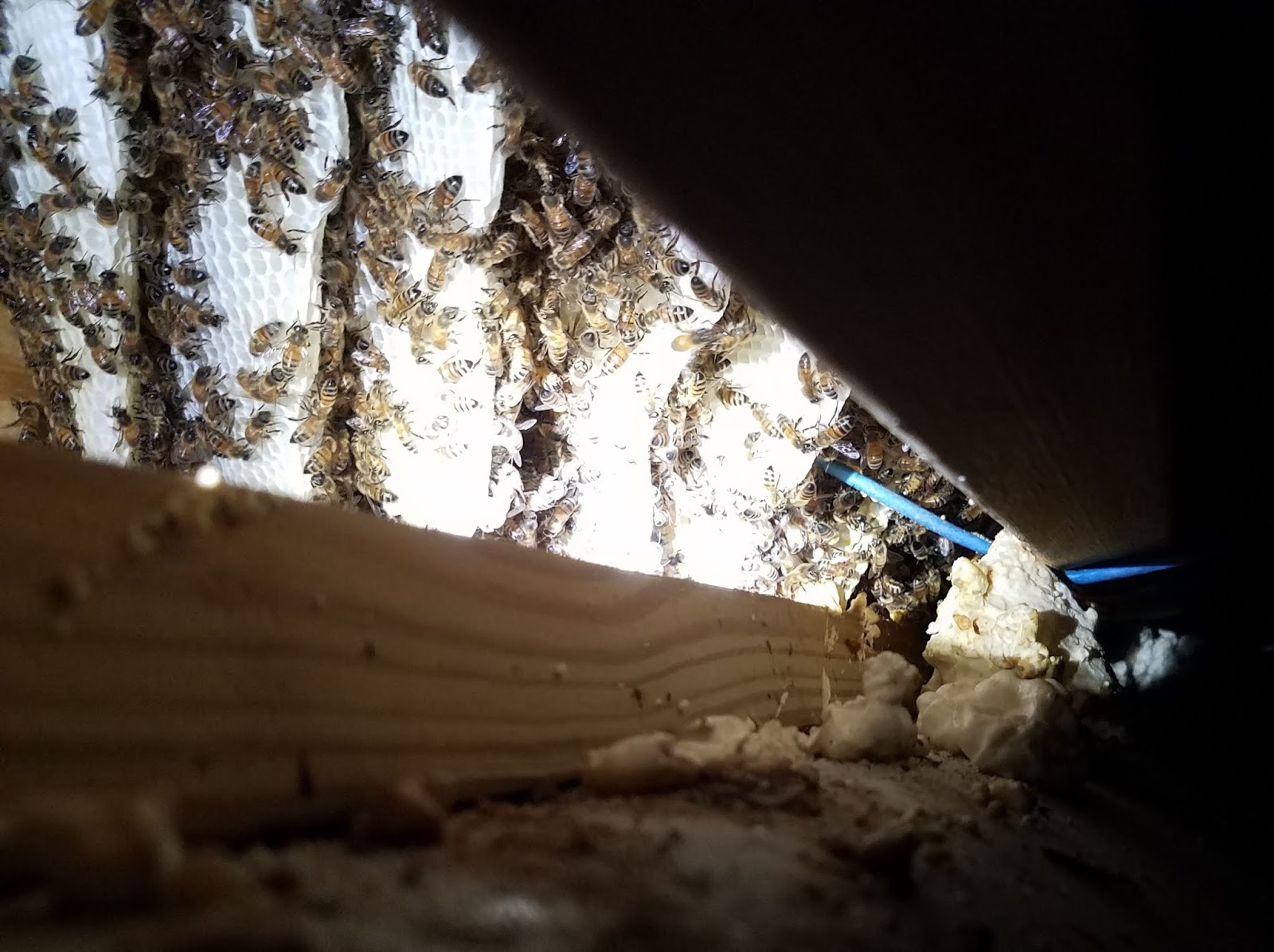
Finally, I had pried and cut and uncovered as much as I possibly could.  I was staring at a 2x12 pine board - a floor joist that bore the weight of the house on it.
  

That's right.  A load-bearing floor joist.  Not the thing you want to cut.  Bees were just on the other side of it.  And on top of the pine boards was the subflooring - another layer of OSB.  Immediately on top of that was the wall studs.
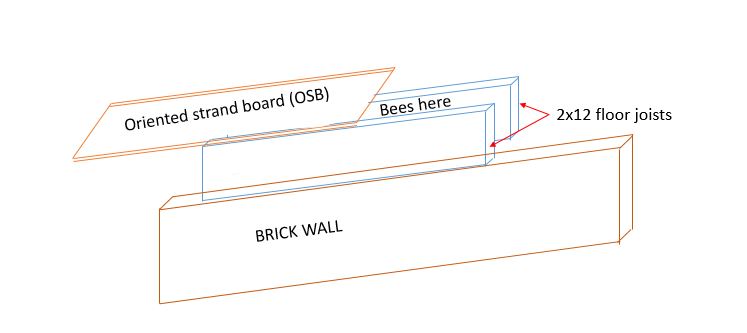
Rough diagram of the Cutaway of the corner


I now had a full inventory of what was there.  What I did not have, apparently, was a way in.

Can't cut away the brick.  Can't cut away the load-bearing joist.  Can't cut away the subfloor that the wall sits atop.  Cutting the wall does not do any good - it won't get me into the void.


I sat on my bucket, wondering why I had decided that this was a good way to make some extra money.


And here we join again where we started the blog entry. I stared at the wall, hoping solutions would appear.  Solutions failed to appear.  I stared some more. Solutions persisted in their absence.


I went back under the house, intent on doing more than just a spot check.  Sure enough, there was a tiny, two-inch crack between the joist and the brick. Maybe enough to get my hand between the boards.  And in that crack, there be bees - bright, beautiful comb clearly visible.


As I backed out of the crawlspace under the house, my hand rested on something papery.  My flashlight identified it as an 8-foot snakeskin. 


Now, friends, my option is to go under the house, sharing tight quarters with what might be a snake, focusing on the removal of bees from a remote location where I only have a 2" access crack, on a 95-degree, 100% humidity day in August.  Or I could go home and drink cheap beer.


Beer never sounded so good.


With a lot of grunting and maybe some swearwords, I folded myself into the space and started cutting out the comb.  After the second piece of comb, the nectar and honey began to flow downward.  Onto me.  I got coated in dripping honey and nectar for the next hour, and then needed a break.

I shared the wealth with the Bodrons, who looked suspiciously at the pieces of honeycomb with bees still attached.  "How do you eat it?"  A couple of bites of pure, unadulterated honeycomb later, and they both were convinced that fresh honey was something special.


"One thing to know", I explained.  "This is not honey.  It is only honey after it gets to a certain humidity level, and we stopped the bees from getting there.  As it is, it will ferment, so you will need to screen it and keep it in the fridge - it simply won't last very long."


One sip of water later, it was time to go back in.  I cut away more comb, finally beginning to see brood comb.  There was absolutely no way to keep the comb intact, because it all had to be compressed (read: squished) to get it out of the gap between the board and the brick.


Another hour later, and I am dripping honey from every spot on me.  I finish up the cutting out of the comb, and brush the cluster of bees into a bucket, before hauling them out and transferring them into a box that is waiting on them.


Each time I come out of the crawlspace, it gets harder to convince myself to go back in.  But several more trips, and I have cleaned the areas out as well as I can, I have dosed the area liberally with poison to discourage the bees from coming back, and I have sealed up as much as I can with expanding foam sealer.  I have vacuumed up, cleaned up, and treated as much as I can.


I slide myself out from under the house, gather up the stuff I need, and trudge to the truck. 

It ends up taking two more trips out to complete the tasks associated with the removal, and every time I get in my truck I find a new spot that has honey residue still sticking around. 
But the bees have been deposited in their new home, and were last seen happily buzzing around all of the nectar-honey that I had fed back to them.  Hopefully making a new home where they were wanted.

And I headed for that beer.  Straightforwards.


Sunday, March 3, 2019

Taking, Pried In my Work, with a Stinging Postscript

Back at it.

(If you just want to read about me getting stung repeatedly, skip to that part of the story at the bottom of the entry, under follow-up:)

I was determined today to remove the eave bracket and get at the honeybees inside.  Suited up, grabbed the crowbar, and started crowbarring.

The first part of the removal I attacked was the molding over the top.  It came out pretty easily, even with the 150-year-old cut nails holding it in place.  This action did not expose any bees to the elements, though.  Above the eave bracket was just a wood block, and above the block, open space.  And a lot of cobwebbing.

Next I worked on prying the bracket loose from the wall.  The more I pried, though, the more that it seemed that everything was giving way, while the eave bracket was holding firm.

One other thing occurred to me as I was tugging at it.  As I twisted and pried, the force of my effort was vectored away from me. Simple physics (PhuFy!). Problem is, there is nothing that could prevent it from breaking loose and falling over the edge, making it into a heavy metal block filled with lots of unhappy bees, unprepared to meet the ground with intense deceleration trauma.  In the process, the eave bracket, a lovely piece of 150-year-old cast iron, would meet an unhappy demise, as well.

Long journey home.
I had already requested that the people parked directly beneath the edge please move their cars.  But I really did not want to lose either bees or bracket.


So I tied off some string to the bracket, and tied it to another bracket, 15 feet away.  That seemed crazy flimsy, so I looked around for something else.  Finally went down to the truck (my fifth trip down 4 flights of stairs) and got a tie-down strap, and tied it off to the same adjacent bracket.

Tightened it down.

By this time, the bees are getting a little curious.  It is a cool day - temperatures in the high 40s - and they are reluctant to venture too far from the warm hive.

But as I started to pry... they got more excited.

I alternated prying and ratcheting, until I started to see it give.  Just a little to start off with, and then increasingly as I pried more.  Finally, it gave way, and dropped.  75 pounds of bees and cast iron and sand (Wait... sand??) and comb all fell and landed at my feet.  Removal with a bang.

It did not go over the edge.  Win.

The bees, however, did not consider this a win.  In fact, they considered it a very upsetting loss, and began to let me know about it in no uncertain terms.


I took the comb out, piece by piece, salvaging whatever I could so I could place it in the box that I had prepared for it.  By this point the bees had calmed down, as it was pretty chilly. Their focus was on getting as much of the honey out as they can, and balling up around the queen.

Who was elusive as she could be. Queen of hide-and-seek.

The sand inside was a bit of a mystery at first.  But when I looked at the inside of the eave bracket, there was a series of clay molded pieces inside - the work of dirt daubers.  Apparently, when the bees took over, they ousted the dirt daubers, and just built on top of the old mud... some of which dissolved and collected inside as a sand bath.

After cutting all the comb out, I took the eave bracket and placed it on top of the empty box, that had new comb interspersed in it.  With both cold and wet weather coming, I am skeptical of whether it will be good for the girls.  But I hold out some hope.

There was a little bit of honey remaining, and the girls had just started to put together some new stores after a long winter.  Since I removed those pieces, I will need to feed them to keep them going until they can do it on their own.

There is another hive at Duff Green Mansion.  In a couple of weeks, I will be able to get it, using a lift.  But from this hive, I was able to find out the piece of information that I needed to make that next one go smoothly.

There is a metal brace underneath the eave bracket that supports it.  This was the piece of information that I needed.  The bracket beneath holds the bracket in place, and once it is removed, the bracket comes loose.

My frustration in last week's attempt at this was that I had removed the bolts, but had not seen the brace.  So prying did me no good.  This time, brute force and ignorance won, but it also gave me the information I needed.  By removing the bolts, and removing the screws that hold the brace in place, I can easily remove it.

Maybe not easily hold it.  But definitely remove it.

Follow-up:

The night after removing the eave bracket and encouraging the bees to enter the box, we got rain.  Cold rain.  It was bad, and I was pretty sure that any bees that survived were going to be in bad shape.

So I decided to rob my healthy hive of one frame of nectar very quickly, so as not to disturb them too much.  Quick in, quick out, nobody will be too upset.

Wrong.  Very wrong.

Usually, when I am doing things with minimal impact, I'll put on a veil and maybe a long sleeve shirt. And sometimes I'll work without smoke.  This time, I took time to suit up and got my smoke going first.  Every precaution.

Those girls boiled out of the hive and started working on my suit, sacrificing themselves by injecting venom into the cloth with reckless abandon.

Eventually, one or two of them found a crease, and injected a little venom into a leg.  And an arm.  Then a shoulder.  Still they came boiling out.  Smoke did not deter them.

Then I felt a sting on my neck. I glanced down to see if I had managed to leave a gap in the zipper-velcro seal at my throat.  Nope.  But there she was, inside with me.  Still trying with every bit of energy she had to hurt, rip, damage the intruder to HER hive.

Then another appeared.  Walking across my throat, with similar intent.

Bees by the hundreds, covering mask.  Covering my jacket.  Covering every surface.  I cut my work very short, and left with the first piece of hardware I could pry free, closed up the box as quickly as I could, and fled.

They followed, grabbing on and stinging with evil glee.  More arm stings, leg stings, and five more bees in my bonnet.  (That expression was never more apt.) I dropped the frame with a slight amount of nectar into the back of the truck, and went back to rescue my smoker and tools.  When I did, the girls came back after me with renewed vengeance.

I had heard of hot hives, but this was the hottest I had ever experienced.  They were MAD.  Clearly, these girls had spent WAY too much time playing first person shooter games.  They didn't even care that it was just one bullet that they carried.

I shook off as many as I could, and got into my truck, still suited up, with bees all over me.  I cracked the window (weird fun fact: bees will leave if the window is cracked, but not if it is wide open), and a few bees made it out.

And then, one block down the road, the bees inside my suit all decided to get me at once.

I pulled over, jumped out, and stripped my suit, shaking off as many bees as I could.  Still they came after me.  One on my scalp.  Another at my throat.  And my eyebrow.  Now that my arms were bare, they were looking lasciviously at long expanses of exposed flesh.  Looking to do violence.  It was then that I noticed a hole in the mesh in front of my face.

Note to self: check mesh BEFORE getting into an altercation with defensive bees.  Not during, nor after.

I got back in the truck.

The whole trip back to Duff Green, bees flew at me while I was driving. I checked twice before going through the house, because I really didn't need additional angry bees introduced into the Bed and Breakfast.  Not good for business (either theirs or mine).

When I got up to the top, it looked like the bees had not made it.  I turned the eave bracket over, and there were no bees in the box.  Over at the wall, there were a pile of dead bees still attached to one another where the bracket had come down.

And so I turned the bracket over, and out tumbled a slightly damp mass of sad, unhappy bees.  But they were alive.  And the first girl to show up, right on the top, was Mary Lake, queen bee of Duff Mansion herself.  I grabbed a queen clip, trapped her quickly,  and dumped her in the box.

A few minutes later, I had swept as many live bees into the box as I could, and placed the stolen - and dearly paid for - frame of nectar into the box, and closed the lid.

Cleanup will come another day.

On the way home, more bees warmed up.  And they, too, stung me.

So I am writing up my results with one eye half swollen shut, and a silly grin on my face.  Those girls are going to do OK.  Lady Xoc is laying like crazy, and making some crazy bees to defend her turf.

Wednesday, October 10, 2018

Late-Season Removal

The bees were pretty aggressive.  That was a change.
The lift.  Bees were located between
the two windows on the right

Several months ago, Mrs. Joyce Clingan called me and asked me to remove the bees that were in the corner of her home.  We had planned to schedule the removal to coincide with the fixing of her gutters.  She already needed to rent the lift, so why not combine the tasks, and just rent the lift once?

Made sense.

Of course, the gutter repairs had been delayed, and life had intervened.  Now it was several months later, and had gotten to a time when translocating bees can be difficult, but.... it was also time for the bees to go.  So she simply went ahead and rented the lift. Friday morning, I gathered my materials, and went over to see if I could figure out how to use the machine that would make my life easier.

After spending a little while getting used to the controls, I got to work.  Having the lift beats the heck out of climbing a ladder and balancing everything at every step.  I started off with the prybar, and pulled loose the fascia board, to expose the first section of bees.

Bee stinger - removed from the author's nose....
Predictably, the bees were sincerely unhappy about this development, and reminded me repeatedly why it was a good idea to wear a suit and veil. They also expressed their displeasure with the innocent painter who was walking nearby, and sought me out to confer every time I took a break to get some water (one decided my nose looked like a potential new hive, and climbed in to investigate, and stung me when I objected.  Another worked her way under my baseball cap.  And stung me when I objected.  Yet another found the gap between my jacket and my pants, and my derriere experienced a sharp retort when I sat down.)


Peekaboo!

Sunday, July 1, 2018

Make no Mistake

This was a terrible idea.

After a day, you revisit the site, and vacuum the huge number of bees collecting outside, trying to find their way into the hive using the old entrance.  And for whatever reason, the vacuum is more successful than previous days, and you actually get draw through the bucket.  Thousands upon thousands of bees get pulled in.  High mortality rate, but they are getting removed.  And you can install them into another hive, where they can help out another queen.

About the time you are ready to call it a night, Mr Artiss comes and grabs you to talk about the bees inside.

Turns out, you should have read a little more before sealing the hive, because youwould have read this, as quoted from a blog by Mike Thomson:

NOTE: Whatever you do, DO NOT simply seal up the opening where you see bees entering & exiting. They will simply find another way out of the wall/floor where they reside. This often means that they will find a way into the interior of you home, harassing you and your family.
 (Wait.  Did you just say INTERIOR?!?)

Oops.

Yep.  The bees were congregated inside the window.  Piled inside.  Dead bees by the thousands, and live bees by the tens of thousands.  It was the stuff of nightmares.  With a Blues concert coming up in a matter of days, it was not just a minor issue.  It was something that required immediate, and persistent attention.

You show up the next day, beevac in tow, and climbed up the ladder to remove the bees.  There were BILLIONS of bees, and they all went into the beevac and made a sticky bee sludge (since then, you adjusted the suction, and are killing fewer bees).  After removing all the bees outside, you go inside where the bees were congregating at the window, and remove the thousands of bees there.  The window does not close all the way, and so you mistakenly assume that the bees were getting in through the crevice between the window and the sill.  Lots of bees.

Vacuum still sucking up and killing bees, you worked the room until there were only a few bees remaining.  You use your caulk to fill the space between the window and the sill, and then repeat the process, then repeat the process again, as the caulk settled and the hole opened back up.

And for each day for the next two weeks, you repeat the process.  Turns out that the bees had found a way into the attic, and were going towards the light at the window, congregating at what appeared to be an exit.

Once you have that area sealed up, the bees start finding their way into the auditorium.

By the way, it is now high school graduation season.  And the auditorium has daily events.

You chase your tail trying to eliminate the bees from the place where people are, but there are several stings.  Inside. And nothing you can do about it.

Eventually, the bees inside the walls die, and you are in the clear.  No complaints to the mayor's office.  No lawsuits.  And no allergic reactions.  Just a couple of people who are unhappy about getting stung.


Fortunately, or unfortunately, there is still another hive on the other side of the building.  I suggest you try trapping them out.

Cone Trap - Brushy Mountain Part 2

Regardless of how you got here, whether you simply waited or you used some interim measure to try it first, the time finally comes to apply the cone you bought from Brushy Mountain Bee Farms.  And it works.

The bees are able to get out, but not get back in.  The escaped bees look for a new home, and find one in your hive, hung next to the entrance on the escape ladder, carefully draped and secured over the top of the wall, 35' above the concrete.

For some of you who got here after doing other things, you removed the multiple attempts at sealing off the holes and attached the cone.  For those who came straight here, you sealed up the other entrances with expanding foam sealer and attached the cone.

Either way, the cone directs the bees out of the hive, and does not let them back in.


The result is very exciting.


Bees out and about.... and not going back in.  A couple of adjustments a couple of days later, and the box is close enough to draw the bees into the space that smells like bees.  Once the bees have started to see it as a home, you take a couple of frames of brood stolen from one of your backyard hives, and place them in the box.  And then you wait.

For two weeks you wait, leaving the whole setup alone. Of course, you check it out every other day, just to make sure that the seals hold.

Two weeks later, you take the box down, and open it up.

Inside, you see this:

In the two weeks since you put two frames of eggs and brood in the box, the bees inside have taken three of those eggs and made them into queen cells, fed the larvae, closed her up to let her pupate, and then waited.  And she emerged!

You look carefully through the five frames to see if you can could find her (virgin queens are harder to spot) or if she was laying yet. No eggs.  Someone who might be a queen....  but not sure.

Either way, she is there.

And...

She has already started taking care of business.

One hive, One queen.  Inviolate rule.  So, since the bees in the box raised THREE queens, her first job is to eliminate rivals.  She emerged first, and then quickly ran over to the other two, chewed an opening into their pupa cells, and stung them to death.

Ruthless. But effective.

The workers then pulled the carcasses of the dead queen bees out and discarded them, leaving behind a ragged shell of what originally housed royalty.

You are pretty sure that you arrived on day 17 of the queen's life, after she emerged, and before her mating flight.  There were no eggs or brood in the hive.  But you now have a hive with a viable queen.

Partial success to your mission of removing the bees!

Meanwhile, more bees continue to emerge from the auditorium, and they seem to find their way into the box.  At this point, however, you are trying to figure out whether to try another box to capture the remainder of the bees.  After all, the bees emerging from the hive in the wall are not welcome in the new queendom...

Huge success here.  You should be proud of yourself.  And please, help yourself to a little celebration for your success: a cocktail that truly fits the bill: the bees knees.

Bee's Knees


Taking the Job

"Mr. Lawton?"

"No, ma'am.  That was my dad.  I am just Crorey."

"Oh."

Not an unusual start to a conversation - it usually starts this way.  After introductions, get down to the business of signing contracts, and walk out with a contract for $200 per hive removal.  Discounted because the city is letting you use their ladder.  The height is a little intimidating, but is OK, because you just signed with the city to do work.

One side of the building has a hive - and the hive is next to a tree.  The other side of the building has another hive, and there is nothing there to hang on to - but also nothing to get in your way.  Both of them need to be removed, and need to be removed safely.  For neither of them can you actually tear open the wall.

Your first decision is which side of the building to address first.  Since you are new at this, you pick the one where there is something to grab onto.  It means that there is a little bit of wiggling that you have to do to get to the top, but once you are there, there are sturdy branches to brace yourself against.

The second decision is more important.  How do you coax the bees out?

Your equipment is limited.  You have a vacuum that has been modified to pull bees out, and a bucket that the bees get drawn into (a better design by Dr. Scott Johnson is detailed here).  And you have the traditional smoker and suit.  And finally, you have sealer - a can of expanding foam that will allow you to seal the other entrances, and ensure that you catch the whole hive.  The final ingredient that you have is:

...a fair amount of chutspah.

....and urgency.  There are a number of events planned for the auditorium, and the city wants the participants of each to have a bee-free event.

Two ways to proceed:  Do you:

a) Set up the ladder and the vacuum and get started?  Click here.

or

b) Go back to the house and read more about trapping out bees.  Click here.


Vacuuming the Bees

You meet with the person in charge of the auditorium, and are immediately put at ease by his easygoing demeanor and easy smile.  After showing you how to find the ladder, Mr. Artiss opens the door to let you hook up the vacuum.  You have coordinated with a co-worker to meet you and hold the ladder - Lee Robinson is fearless, and ends up being a perfect choice.

Hook up the vacuum to the bucket, with the mesh bag inside the bucket to catch the bees, hook up the other hose to the lid, and cinch the shopvac tight against the 7' ladder, and you are ready to go. You started at dusk, when most of the bees would be returning from the field.

I don't know if you know this, but you are VERY much afraid of heights.  And the 30' ladder provided by the City of Vicksburg is pretty rickety. But in the face of such predicaments, you forge ahead.  Because you have chutzpah.

Lee holds onto the ladder, which is wedged between the tree and the building.  And you begin the climb, squeezing between limbs and the brick wall, up three stories.  After tying off the bucket to the ladder, as high as it will reach, you grasp the hose, and give the signal to Lee, who turns on the vacuum.

And the bees begin to disappear down the gullet of the bee vac, making a satisfying sound as each gets sucked backwards.  (Your hose, however, creates a harmonic, resulting in a band-saw like scream that is painful on the ears.  Note to self: the next time you do this, you should probably bring some headphones).

After five satisfying minutes of watching bees get sucked into the machine, you realize you are leaning further and further in towards the entrance to the hive.

Oh, no.  Your vacuum doesn't suck.  Or, depending on your perspective, it does.

So you descend the ladder, carrying the bucket of bees to the ground.  And you transfer them to the spare bucket, an act that makes Lee hightail it away from your spot, as the bees emerge QUITE unhappy with you as a result of their journey.

Now that the bucket is cleared of bees, you ascend, and discover that the vacuum still sucks.  Or, rather, that it does not suck.

Darkness is coming.  You do not have illumination.  What do you do?

Keep working.  The hole won't change its location, so you can easily use your now-failing vacuum to not suck up angry bees in the dark while on top of a 30' ladder.  Click here.

Seal up all holes except for the one you are drawing from, and plan to try again tomorrow. Click here.


A New Day

It is a bright, new day, and you have it all figured out.

Overnight, you worried the idea over and over.  And finally decided on a course of action.  You are going to swap out your ShopVac for the one your wife has.  Hers is more powerful, and won't lose suction so easily.  You have installed the bees from last night's efforts into a new box.  There is a bit of unhappiness with the bees there, and a lot of casualties involved in the effort, but without a nearby hive to migrate into, they are mostly staying in the box.

After sealing all except the entrance you want
to vacuum, the bees begin to congregate
And, again at dusk,  you return to the scene of the crime.

7' ladder, up.  New, more powerful ShopVac plugged in, and secured.  Clean mesh bag in the retrieval bucket, connected to the vac with a hose, and secured on the tall ladder.  Hose connected to the top of the bucket.

You climb the ladder, and give Lee a wave.  He fires up the vacuum.

And, suddenly remembering the importance of the headphones, you give him the signal and descend.

Removing the gear, you put the headphones on, and put the veil and the jacket back on, and climb the ladder again.  Vacuum on, the bees start to get sucked into the bucket.  It is working.  Powerful vac FTW!

And five minutes later, with the sun dropping further on the horizon, you begin to noticing decreased suction.  Again.  Testing the hose on the back of your glove you confirm that your new vacuum sucks, as well.

Aw, crapola.

As before, you descend with the bucket-o-bees, transfer them to the spare bucket, re-climb the ladder and start it up again, and the vacuum declines to pick up any more bees.  At this point you are:
  • High up an unstable ladder, with
  • Angry bees all around, with
  • A useless tool in your hand.
You are at a crossroads.  You are expected to complete the task in short order.  You want to get paid, but more than that, you want to complete the job. Which means, get the bees away from the people.  Into a new home is preferable, but if not, you are paid to remove the bees.

You have a choice.  You can:


Aluminum Screen

OK, you have decided to go with an aluminum screen cone.  Good call.  Aluminum screen is hardy, weather resistant, and a little bit pokey - so you can keep the bees from reentering.  So now you are off to the local hardware store to buy an $8 roll - the smallest available - of aluminum screen wire.  Pretty easy, and lots of replacement for when the first cone doesn't work.


You roll the cone as tight as possible, so that the bees can only get out one at a time from the tip of the cone.  You fray the edge, so that all the pokey edges are pointing outward, making it harder for bees to return. And you seal up all of the other holes with expanding foam sealer, so that the bees have to go through the cone to emerge.  The expanding foam sealer is goopy and sloppy, but after about ten minutes on the ladder (surrounded by very anxious bees), you can let go of the cone and it stays where it is.  A little bit extra foam around the base to ensure that all of the holes are sealed up, and you are good to go.

Now it is time to place your trap box.

Your concept: Take a small box, of a shape and size that will be attractive to a swarm of newly homeless bees, and give them a place to live.  Put frames in there, so that they can build comb, store nectar and pollen, and arrange living space.  And perhaps most importantly, steal a frame of brood with eggs and ready-to-emerge bees, from another hive, and put it in.

The bees will take one of the eggs, perhaps more, and turn them into queens.  At least, that is the theory.  And then you hang your box.

This is not a simple task.  You can't drill into the side of the building - it is historic brick.  Besides being hard to do, it is also a structure of cultural significance, and randomly drilling holes is frowned upon.

So you come up with two solutions: a) you can tie the box off to an anchor of some sort (you decide on a window weight from an old fashioned window - $5 at the antique store) or b) you can buy an escape ladder ($35 from your hardware store), and attach the box to it. (You decided on the escape ladder.)

You are using the cardboard box you got when you bought your bees, and there are three of them, so you are good on that front.  Now it is just a matter of anchoring it to the hanging ladder.  Do you:

Attach it using tie-down straps?  Click here,

or,

Attach it using bungee cords? Click here.


Sunday, May 13, 2018

Bees Inside


Bee-tween
the window and the drapes.
I love bees.  Bees are a delightful part of nature.

But. 

Nature, I am told, is intended to remain outside the walls of our homes.  To establish our safe haven within a location of our choosing, we beat back the weeds and the animals and the insects, and we sanitize and create our space to our own desires.

Our space. 

Very rarely are bees expected to be part of that space. And certainly, any situation where bees have unfettered access to that space is to be avoided.

Last week I got a message.
Facebook message from Mr. Smith's sister, Portia

Bees.  Inside.

As my sister said, "Nope."

The house is beautiful.  It is made to look like the limestone that faces the buildings at the front of the Tulane campus, and has a lovely feature (tower? keep? machicolations? I don't know.) on the southeast side of the house. When the owners got in touch with me, they referred to the house as The Castle House.  Originally from Vicksburg, they had purchased the house as a family home, eventually to be passed on to their granddaughter.

And there are bees inside the house.

Nope.


So my job was to remove the bees from a beautiful, turn-of-the-century home.  My goal was to remove them safely, get the queen ensconced in a new hive, and bring enough of her loyal subjects and resources to get the hive started in a new place where they could thrive.

My job has been done.  The bees are no longer in the house.
Bees entering from the base of the window.

I did NOT, however, reach my goal.

The whole job was a learning experience, and there were a host of unknowns from the start.  How far down did the bees go?  How far up?  Which studs defined the limits of their space?  How were they getting into the house?  

The first piece that provided a difficulty was the shape of the room.  Yes, the room the bees decided to inhabit was a circular room.  The plaster work for the room was done at a time - back in the early 1900s - when work in plaster was a common craft.  

Nowadays, to find a good plaster guy, you will pay big.

My first schematic.
The bee bag got drawn into the hose
at the bottom, clogging it.
I promised Mr. Smith that I would cut as little as possible to remove the bees.  My first step was to drill a hole in the wall, allowing the bees a specific place to escape.  I would use my beevac to suck them up.

Now Best Beloved, my beevac needed some tinkering.  On a different job, the suction completely disappeared, while I was up on a 30' ladder.  Situation: less than ideal.  So with the help of my inventor-brother Parker, I modified the design so that I could draw the bees through the hose and into the bucket/bag combination.

Parker's suggestion was to add a tube at the bottom, and perforate it, so that there were more than one place for the vacuum to draw.  It was similar to the design I had originally used - before the introduction of the paint-strainer-as-bee-bag.

The draw, as a result of his suggestion, was vastly improved.  

I drilled holes in the wall of the upstairs room in The Castle House, and the bees began to emerge.  Because I was working inside, I could not use the smoke to calm them down - there is something about bedsheets and mattresses and smoke that don't mix.

So I beevacked.  Slowly, the numbers of curious bees started to abate, and I cut the hole open wider.  The opening ended up being about 18" high by 12" wide - enough to get my gloved hand in with the vacuum, but not much room for maneuvering. 

And there were bees downstairs as well, which meant that it was possible that the hive extended below the floor and into the wall on the first floor - a big uncertainty that I needed to deal with eventually.  But first, I had to start removing the comb.  

The first bit of comb I encountered was old, abandoned comb - the bees had gone lower in the wall since they had built that first piece.  To get the comb out easily, I was going to have to expand.

Discussions with Mr. Smith did not get far.  I wanted to cut through the base board precisely, to expose more of the comb so I could remove it carefully. I do understand his response ("No.") because replacing it would be tough, no matter how careful I was.  I used to work for a company that manufactured molding.  Curved molding is an expensive product.

Below the sill, above the baseboard, between the studs.
I also floated the idea of opening the wall downstairs, if the hive extended that far.  That was also met with a negative response.  Again, understandable.  The replacement of plaster on one opening in one room on the second floor is expensive, but doable.  The downstairs room, though, is pretty much the centerpiece of the home.  "Crorey, if the bees extend down that far, we will just have to fill them in; I can't open the wall downstairs."

I continued to remove comb.  At first, all of the comb was empty, with no honey or brood or pollen.  As I got lower, there was brood.  And as carefully as I tried to extract it, I bruised all of the comb as it was coming out, damaging larvae and pupae as I did so.  

Meanwhile, the vacuum continued to do its work. 

At one point, I left the beevac running, with the hose in the wall, and went downstairs for a glass of water.  When I returned, the hose had fallen out of the wall, and there were a large number of bees that had wandered up to investigate the new situation.
Veil up selfie.  The way it should be.

I ran over to the hole, and began vacuuming them up, and they reacted predictably.

Ow.  OW.  OWW!

It was at this point that I decided to pull the veil back over over my head.  Something I should have done BEFORE I approached the bees, but in my haste to prevent a bee jailbreak, I forgot.  Nose, scalp, scalp.  Not bad, considering, but a definite reminder to slow down and then react, rather than react first, and then think....

I continued to remove comb, encountering a nail in the wall that limited my access, and eventually encountering a floorboard that extended into the wall space, as well.  Each piece of comb removed was preceded by multiple attempts to remove the bees into the beevac.  
Old, disused comb.
Another 18" of removed comb.  Nail between wall and siding.

Nail removed, more comb removed, revealing floor board obstruction.
Comb.  Sadly, I was not able to remove the brood comb intact. 
Beneath the floorboard was the best brood comb I encountered.  Removing it required that I reach under the floorboard, grasp the comb, break it free, and then snake it out through the opening between the wall, stud, siding, and floorboard.  All while wearing a glove to ensure that I got stung the fewest times possible.

Eventually I had to remove the glove, and dive into that space barehanded, to retrieve the comb.

The comb extended to the ceiling of the first floor, where I hit a hard surface.  The rest of the afternoon was spent removing the fragments of comb from different crevices across the opening.    

Closed up the hole, vacuumed up debris, and ready to go.
Once all of the comb was removed, I wiped all the interior surfaces down with ammonia.  Several bees who had hidden in different places in the hole suddenly erupted into the room, more than a little upset at having been gassed out of their game of hide-and-seek.  After consigning them to the interior of the bee vac, I sealed the inside corner with foam sealer, closed up the hole, and vacuumed up the remaining plaster and wood, dead bees and comb from the room.

I then took the vacuumed bees home, and placed them in a hive box.  I never saw the queen, and suspect that she was KIA.  I remain very conflicted about removal that does not net the queen, because it means I still have a lot to learn.  

I finalized the process by climbing up to seal the exterior with silicone.  And the job was done. 

The job was done.  But the goal still remains.  I want to do better.  I want to improve the bee vac to make it gentler on the bees.  I want to take my time and find the queen, so that I can complete the task and introduce the bees to a new home.

Mr. Smith wore my spare veil while I transferred bees from vac to bucket.