Showing posts with label helping out. Show all posts

Tuesday, August 6, 2019

Straightforward. Yeah, right.

"WHY would I use the word 'straightforward' in ANY sentence involving beehive removal work??"

I stared at the wall, hoping solutions would appear.  Solutions failed to appear.  I stared some more.  Solutions persisted in their absence.


The job was supposed to be relatively straightforward.  My boss at the Corps had a hive that had shown up at his house, and had taken up occupancy as unwanted guests.  He had asked me to go and take a look.  I looked.  The house had shiplap siding, and the bees were coming and going in an interior corner in the building. 


I looked under the house in the crawlspace, and there was no evidence that the bees had any access to the space under the house.  No sound, no motion, no dead bees at the entrance. 


And no comb to be seen anywhere.


My proposed approach, then, was,

  1. Remove shiplap siding, cutting away just enough to expose the comb,
  2. Remove the comb, brushing away bees into prepared boxes, 
  3. Place any recently laid brood comb in the boxes, 
  4. Vacuum any remaining bees, 
  5. Clean up, 
  6. Claim my check.

It was a hot day, but the work should be pretty easy.  My only concern was how to minimize the damage to the siding.  "This appears to be a pretty straightforward job," were the words that came out of my mouth.


I arrived on Sunday afternoon, all smiles and selfies.

Happy beekeeper.  It would not last.

First step: remove shiplap siding.  Since I had not actually tried to remove any of the siding before I got the contract signed (it is considered bad form, apparently, to start demo before you get approval),  I was worried that the siding was HardiePlank - the concrete siding.  If so, I was in for a rough go of it on the demo.  That stuff is tough to cut.


Turns out, it was the masonite variety - much easier to break/remove/cut.  I breathed a premature sigh of relief.


And got to work.  First obstacle was the presence of a moisture barrier (easily dealt with) and a layer of waferboard (OSB) under the siding.  Not completely unexpected, but it made the job a little tougher.  So instead of just prying the boards loose, I was going to have to cut them out. 

Reciprocating saw to the rescue!


After I had cut deeper than I had thought was necessary, I pried up a section of the OSB, and found wood underneath.  I cut a wider swath through the OSB, and uncovered more wood.  And then more. 

And more.


Finally, I had pried and cut and uncovered as much as I possibly could.  I was staring at a 2x12 pine board - a floor joist that bore the weight of the house on it.
  

That's right.  A load-bearing floor joist.  Not the thing you want to cut.  Bees were just on the other side of it.  And on top of the pine boards was the subflooring - another layer of OSB.  Immediately on top of that was the wall studs.
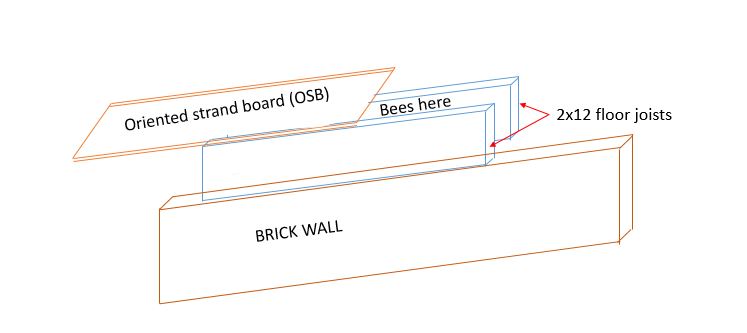
Rough diagram of the Cutaway of the corner


I now had a full inventory of what was there.  What I did not have, apparently, was a way in.

Can't cut away the brick.  Can't cut away the load-bearing joist.  Can't cut away the subfloor that the wall sits atop.  Cutting the wall does not do any good - it won't get me into the void.


I sat on my bucket, wondering why I had decided that this was a good way to make some extra money.


And here we join again where we started the blog entry. I stared at the wall, hoping solutions would appear.  Solutions failed to appear.  I stared some more. Solutions persisted in their absence.


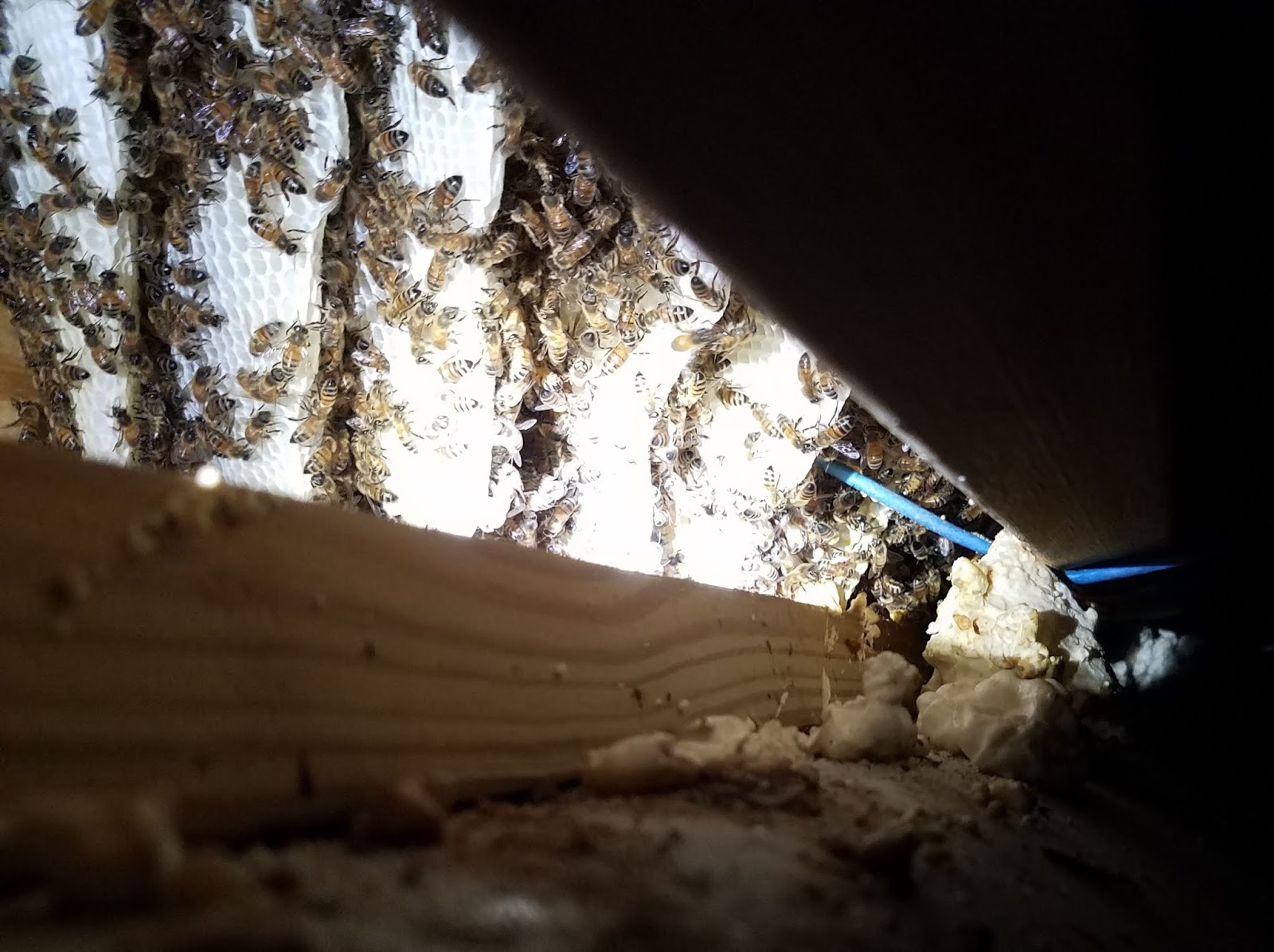
I went back under the house, intent on doing more than just a spot check.  Sure enough, there was a tiny, two-inch crack between the joist and the brick. Maybe enough to get my hand between the boards.  And in that crack, there be bees - bright, beautiful comb clearly visible.


As I backed out of the crawlspace under the house, my hand rested on something papery.  My flashlight identified it as an 8-foot snakeskin. 


Now, friends, my option is to go under the house, sharing tight quarters with what might be a snake, focusing on the removal of bees from a remote location where I only have a 2" access crack, on a 95-degree, 100% humidity day in August.  Or I could go home and drink cheap beer.


Beer never sounded so good.


With a lot of grunting and maybe some swearwords, I folded myself into the space and started cutting out the comb.  After the second piece of comb, the nectar and honey began to flow downward.  Onto me.  I got coated in dripping honey and nectar for the next hour, and then needed a break.

I shared the wealth with the Bodrons, who looked suspiciously at the pieces of honeycomb with bees still attached.  "How do you eat it?"  A couple of bites of pure, unadulterated honeycomb later, and they both were convinced that fresh honey was something special.


"One thing to know", I explained.  "This is not honey.  It is only honey after it gets to a certain humidity level, and we stopped the bees from getting there.  As it is, it will ferment, so you will need to screen it and keep it in the fridge - it simply won't last very long."


One sip of water later, it was time to go back in.  I cut away more comb, finally beginning to see brood comb.  There was absolutely no way to keep the comb intact, because it all had to be compressed (read: squished) to get it out of the gap between the board and the brick.


Another hour later, and I am dripping honey from every spot on me.  I finish up the cutting out of the comb, and brush the cluster of bees into a bucket, before hauling them out and transferring them into a box that is waiting on them.


Each time I come out of the crawlspace, it gets harder to convince myself to go back in.  But several more trips, and I have cleaned the areas out as well as I can, I have dosed the area liberally with poison to discourage the bees from coming back, and I have sealed up as much as I can with expanding foam sealer.  I have vacuumed up, cleaned up, and treated as much as I can.


I slide myself out from under the house, gather up the stuff I need, and trudge to the truck. 

It ends up taking two more trips out to complete the tasks associated with the removal, and every time I get in my truck I find a new spot that has honey residue still sticking around. 
But the bees have been deposited in their new home, and were last seen happily buzzing around all of the nectar-honey that I had fed back to them.  Hopefully making a new home where they were wanted.

And I headed for that beer.  Straightforwards.


Friday, June 7, 2019

Love on the Battlefield

The setting of the National Cemetery at the Vicksburg National Military Park is one of the most peaceful ones imaginable.  The rolling loess hillside, graves in neat rows, each section terraced to provide a continuity among the gathered dead.  Oak trees, expanded to their full canopied width.  Magnificent magnolia trees, filled with heady blossoms.  Ancient crape myrtles and ginkgoes filling in the space.

And one very large downed tree, two terraces distant from the road.

Captain Dan Harder, a friend of mine from my time in Puerto Rico, texted me just before Memorial Day.  "Was at the national cemetery this morning putting flags out; apparently they have a giant tree that fell during the storm they can't remove because it's full of honeybees."

I had a quick conversation with the Superintendent of the park, and confirmed that they were interested in having my help.

Turns out that the giant tree was really a bigger job than I was able to do solo.  Everything I have worked to date has been able to be cut through with a reciprocating saw.  This sucker was far bigger than that.  Fortunately, Aaron Matthews, a friend of mine from work, is looking to get into bees, and offered his chainsaw prowess to the task.

Chainsaw work on the fallen tree stopped where the bees began.
Recon visit didn't tell me much, other than the size of the tree and the size of the entrance.  This is where it gets interesting.  If the bees are only in the very front of the entrance, and fill a space a little bigger than a breadbox, then I don't need to have a chainsaw.  But if it extends back further, I will need the help.

I veiled and reached in to pull out some of the debris in the entrance.

The bees, not unexpectedly, were more attached to their debris than I had anticipated.  Several expressed their displeasure in a very firm manner.

Signs of aggression, check.


Who could blame them?  The opening that they had was a knothole 20' up in a tree.  Now it is basketball- sized hole at a level that any passer-by could reach in easily.  That kind of situation would put any of us on edge.

I returned a week later to try again.  By now, the numbers had increased, and they had covered over some of the external comb with propolis, and they were even more ready to take swift action than before.


Bees covering the full entrance to the hive.
The wood has started to deteriorate, and is soft and crumbly.  They won't be able to stay here much longer anyway.  And as soon as the National Park Service can get the honeybees out, they can take away the tree and dispose of it, and straighten up the graves that were knocked around when the tree fell.

The interior of the log is covered with bees on every surface, and I did not have a way to figure out how deep it goes. 

Only one way to find out.  Reach the hand in and start cutting comb out.  And keep reaching in until there is no comb left.  The hope, of course, is that I don't run out of reach before I run out of comb. As soon as I have cut comb as far as I can reach, we have to move to using the chainsaw.

If the bees do not like people messing with the debris at the entrance to the hive, they REALLY don't appreciate solid chainsaw work.

The all-important selfie.  Obligatory.
One more visit yielded only a little more information.  The bees definitely extended further than I had originally thought.

Saturday started off cool and overcast, which meant the bees slept in, waiting for things to warm up before heading out to forage.  At 9 am, Aaron and I arrived, chainsaw and shop vac in tow. With a borrowed generator from the Military park folk (thanks for coming out, Auston!) we got started.

The initial foray into the hive was daunting. I have been chased by bees before, and I have had an entire hive mad at me before, but this was impressive.  The bees just boiled out of the hive, and enveloped both of us in a cloud of bees that overwhelmed us from the first cut of the comb.

I guess it makes sense.  The bees had been safely ensconced in a tree, safe from the elements and from predators.  I imagine that they lived a peaceful life, with no particular aggression needed to keep them safe.

Then suddenly, as Auston put it, God got mad at 'am, and suddenly they are living in a log that turned their hive 90 degrees on edge, and opened both entrances to the elements.  And to predators.

Auston told us, "Since they can't get mad at God, so they get mad at you."

And get mad, they did.

I looked down and did a quick count.  60 stingers in the back of my glove. Where I leaned forward to reach into the hive, the bees stung my cheeks through the veil.  Four times.  Another half dozen stings hit my hands through my double-thick leather gloves as I reached in.

For an hour, I cut away at inaccessible comb while Aaron helped keep the smoker fueled and fired up to help calm the horde.

Before the log fell, the bees had drawn comb vertically in the hollow of the trunk.  When it fell, that comb is now horizontal - not the bees' preferred position. So they sucked the nectar out, abandoned the use of those parts of the comb, and began drawing comb from the top of the log, and connecting it to the now unused comb stacked at the bottom.
Cross combing
Even so, they maintained the spacing that they needed to do basic housekeeping. So everything is stable, but also built at cross angles to everything else.  Cross angles make it impossible to remove comb cleanly.

And the bees that are now defending the wide open entrance are VERY defensive.


After the first cuts were completed, we pulled enough brood comb to start the bees in their new digs.  Once the box was filled up, we transferred all the comb to Aaron's new bee yard, and ran the vacuum for the first (of three) times, collecting some 15,000 bees in the process.  All of whom got transferred to their new hive.

Very quickly, I ran out of space to work, and Aaron started up the chainsaw.  The top entrance of the hive was quickly liberated, and the entrance in the base of the log widened, so that I could get at more of the comb.

Video taken with a potato....

Twice more, we smoked the bees to the entrance, and twice more, we removed the bees with the vacuum, transferring them to the new hive.

Final step was to feed the honey back to the bees, so they could use it to build the comb in their new box.

I used my newly-acquired Square (TM), and received the agreed-upon funds from the National Park Service. (#SquareOne, #contest).  The transaction was very smooth, and completed the full project perfectly. 

Bees defending high ground
In the final analysis, this was the most aggressive hive I have dealt with.  Possibly also the most bees.  Normally, once I get the entire area open, the bees will settle down and I can work more comfortably, in long shirt and pants with a veil.  These guys would have none of that.  I wore full gear the entire time.... only working without gloves towards the end.  Even then, the bees were feisty.

But I hope that gives them a fighting chance, as well.  We salvaged as much of the cross-combed brood as we could, with which they can raise more bees.  But even so, it might not be enough.    I'll be talking to some friends about installing a queen (we never spotted her) to help the hive establish.  But we'll give the 40,000 relocated bees a few days to build comb and make the hive their home.


And when we do, I'll update you all on the progress.


UPDATE:
"There are 3 bees left."

That was the message I got last night, four days after we removed the hive.  The bees absconded. A large number of them apparently died, within a couple of days of removal, and the bodies piled up.  And the remaining bees took off, leaving an empty hive.

I am going to get a handle on the relocation piece of this business one of these days.   It still seems like such a hit-or miss strategy I employ.  And sometimes it works.  Other times, not.  I usually come up with an after-the-fact explanation (too cold, too slow to move them, too long in the heat, induced robbing).  But the truth is, I am not always sure I know.  It is guesswork.

I need to guess better.

Monday, March 11, 2019

Duff Green Removal, Part 2 (Or How I learned to avoid the sting and love the bomb.)

So most of the time, when I get a call to remove bees, it is because the bees have begun to migrate inside the house.

Not this time.

This was the second hive removal from Duff Green, and the one that I was most worried about.  With the first removal, I was able to stand, kneel, sit, stoop, and walk around the hive until I was able to pry the eave bracket from the wall.  The closest to danger I got was dropping the four feet from the roof to the balcony.  Significant risk to my pride, but no real consequence, since nobody was watching me do it.

The height of the second hive, combined with the fact that there was no easy access, meant that I needed help.


Help came.
Boom.
With the assistance of the truck, I was able to spend my attention on the bees, rather than whether I was able to keep my balance on an extension ladder. 
The hive was visible on the outside of the building, certainly a result of the hive running out of space inside one of the two eave brackets on either side of it.  The comb was attached to both, so it could have been either one.... and I was hoping for the one closer to the truck.  Otherwise, I would be reaching out around the corner to proceed.

But first things first, I started cutting down the comb.

The comb on the outside of the building was very friable.  The bees had sucked out all of the goodie from the comb, leaving a dry waxy husk.  The second and third layers were the same.  Brightly colored comb, with minimal evidence of use.
Two sections removed.  Photo: Kathe Lawton
Then the bees started appearing.  It was a cold day, so there was minimal activity.  Mostly just a couple of flybys telling me to buzz off.   At this point, Mr. Wright, who had accompanied me in the lift up until this point, decided that the roof was a better place from which to direct and observe.  


Each of the successive sheets of comb had more brood and bees on it, and the girls got a little more defensive with each step.  But at the end of the ten pieces of comb, I cleared off the remaining bees to figure out where the entrance to the larger part of the hive was, and I found...


Nothing.


The bees were not accessing the inside of the structure at all.  Like wasps or hornets, they had built the entire thing on the outside of the building, exposed to the elements.

As a result, they were not as strong as the group that had hunkered down in the eave bracket.  Their numbers were reduced, and there was maybe some evidence of a predator trying to gain access.  Very little honey remained, and they were not doing a great job of foraging.  The weather has been pretty rotten - wet and cold alternating in a bad foraging arrangement - so it is possible that they just couldn't keep up. 


The entire group went pretty docilely into the box, and I followed up with a clean-up of the corner, including a dosage of pyrethrins (hornet spray), to discourage future swarms from taking up residence.  Half hour later, and I had the box carefully stowed, the extra way set aside for melting down, the clean up complete, and the truck driver on his way.

Now to hope that they can weather a couple of cold nights in their new complex.  Fingers crossed.

Come out! (Photo: Kathe Lawton)

Heart-shaped hole in the comb.  

I need a fish-eye lens to get the full picture. (Photos: Kathe Lawton)


Postscript:  two of my most common questions:
How do you avoid getting stung? (Um, I haven't figured out how to avoid it, yet.)
How many times do you get stung during something like this? (I really don't know.).

I am not sure how to explain it.  This weekend, I was working with Stephen Coy down in Wiggins, MS, with his operations down there.  While I was working, I started getting stung.  A few bees made it up my pants leg, and started to let me know they were there, in a final gesture sort of way.

The first one, I noted, and kept working.  The second one, I noted, and kept working.  The third one, I figured I had a problem, and moved to the side to deal with it.

But getting stung is just part of the process - not something you go after, just something that happens.  And at some point, you notice, but are too focused on the task to pay attention to the mounting count of stings.  

So I don't know.  I can usually get a count by the welts. But especially if the bees sting through the shirt, only a little venom gets in, and I might not react. 

The bees react, though.  More stings means more fight pheromones in the air.  Means more stings. 

So not getting stung seems one of the best ways to avoid getting stung.  Now if I can just manage that....

Sunday, March 3, 2019

Taking, Pried In my Work, with a Stinging Postscript

Back at it.

(If you just want to read about me getting stung repeatedly, skip to that part of the story at the bottom of the entry, under follow-up:)

I was determined today to remove the eave bracket and get at the honeybees inside.  Suited up, grabbed the crowbar, and started crowbarring.

The first part of the removal I attacked was the molding over the top.  It came out pretty easily, even with the 150-year-old cut nails holding it in place.  This action did not expose any bees to the elements, though.  Above the eave bracket was just a wood block, and above the block, open space.  And a lot of cobwebbing.

Next I worked on prying the bracket loose from the wall.  The more I pried, though, the more that it seemed that everything was giving way, while the eave bracket was holding firm.

One other thing occurred to me as I was tugging at it.  As I twisted and pried, the force of my effort was vectored away from me. Simple physics (PhuFy!). Problem is, there is nothing that could prevent it from breaking loose and falling over the edge, making it into a heavy metal block filled with lots of unhappy bees, unprepared to meet the ground with intense deceleration trauma.  In the process, the eave bracket, a lovely piece of 150-year-old cast iron, would meet an unhappy demise, as well.

Long journey home.
I had already requested that the people parked directly beneath the edge please move their cars.  But I really did not want to lose either bees or bracket.


So I tied off some string to the bracket, and tied it to another bracket, 15 feet away.  That seemed crazy flimsy, so I looked around for something else.  Finally went down to the truck (my fifth trip down 4 flights of stairs) and got a tie-down strap, and tied it off to the same adjacent bracket.

Tightened it down.

By this time, the bees are getting a little curious.  It is a cool day - temperatures in the high 40s - and they are reluctant to venture too far from the warm hive.

But as I started to pry... they got more excited.

I alternated prying and ratcheting, until I started to see it give.  Just a little to start off with, and then increasingly as I pried more.  Finally, it gave way, and dropped.  75 pounds of bees and cast iron and sand (Wait... sand??) and comb all fell and landed at my feet.  Removal with a bang.

It did not go over the edge.  Win.

The bees, however, did not consider this a win.  In fact, they considered it a very upsetting loss, and began to let me know about it in no uncertain terms.


I took the comb out, piece by piece, salvaging whatever I could so I could place it in the box that I had prepared for it.  By this point the bees had calmed down, as it was pretty chilly. Their focus was on getting as much of the honey out as they can, and balling up around the queen.

Who was elusive as she could be. Queen of hide-and-seek.

The sand inside was a bit of a mystery at first.  But when I looked at the inside of the eave bracket, there was a series of clay molded pieces inside - the work of dirt daubers.  Apparently, when the bees took over, they ousted the dirt daubers, and just built on top of the old mud... some of which dissolved and collected inside as a sand bath.

After cutting all the comb out, I took the eave bracket and placed it on top of the empty box, that had new comb interspersed in it.  With both cold and wet weather coming, I am skeptical of whether it will be good for the girls.  But I hold out some hope.

There was a little bit of honey remaining, and the girls had just started to put together some new stores after a long winter.  Since I removed those pieces, I will need to feed them to keep them going until they can do it on their own.

There is another hive at Duff Green Mansion.  In a couple of weeks, I will be able to get it, using a lift.  But from this hive, I was able to find out the piece of information that I needed to make that next one go smoothly.

There is a metal brace underneath the eave bracket that supports it.  This was the piece of information that I needed.  The bracket beneath holds the bracket in place, and once it is removed, the bracket comes loose.

My frustration in last week's attempt at this was that I had removed the bolts, but had not seen the brace.  So prying did me no good.  This time, brute force and ignorance won, but it also gave me the information I needed.  By removing the bolts, and removing the screws that hold the brace in place, I can easily remove it.

Maybe not easily hold it.  But definitely remove it.

Follow-up:

The night after removing the eave bracket and encouraging the bees to enter the box, we got rain.  Cold rain.  It was bad, and I was pretty sure that any bees that survived were going to be in bad shape.

So I decided to rob my healthy hive of one frame of nectar very quickly, so as not to disturb them too much.  Quick in, quick out, nobody will be too upset.

Wrong.  Very wrong.

Usually, when I am doing things with minimal impact, I'll put on a veil and maybe a long sleeve shirt. And sometimes I'll work without smoke.  This time, I took time to suit up and got my smoke going first.  Every precaution.

Those girls boiled out of the hive and started working on my suit, sacrificing themselves by injecting venom into the cloth with reckless abandon.

Eventually, one or two of them found a crease, and injected a little venom into a leg.  And an arm.  Then a shoulder.  Still they came boiling out.  Smoke did not deter them.

Then I felt a sting on my neck. I glanced down to see if I had managed to leave a gap in the zipper-velcro seal at my throat.  Nope.  But there she was, inside with me.  Still trying with every bit of energy she had to hurt, rip, damage the intruder to HER hive.

Then another appeared.  Walking across my throat, with similar intent.

Bees by the hundreds, covering mask.  Covering my jacket.  Covering every surface.  I cut my work very short, and left with the first piece of hardware I could pry free, closed up the box as quickly as I could, and fled.

They followed, grabbing on and stinging with evil glee.  More arm stings, leg stings, and five more bees in my bonnet.  (That expression was never more apt.) I dropped the frame with a slight amount of nectar into the back of the truck, and went back to rescue my smoker and tools.  When I did, the girls came back after me with renewed vengeance.

I had heard of hot hives, but this was the hottest I had ever experienced.  They were MAD.  Clearly, these girls had spent WAY too much time playing first person shooter games.  They didn't even care that it was just one bullet that they carried.

I shook off as many as I could, and got into my truck, still suited up, with bees all over me.  I cracked the window (weird fun fact: bees will leave if the window is cracked, but not if it is wide open), and a few bees made it out.

And then, one block down the road, the bees inside my suit all decided to get me at once.

I pulled over, jumped out, and stripped my suit, shaking off as many bees as I could.  Still they came after me.  One on my scalp.  Another at my throat.  And my eyebrow.  Now that my arms were bare, they were looking lasciviously at long expanses of exposed flesh.  Looking to do violence.  It was then that I noticed a hole in the mesh in front of my face.

Note to self: check mesh BEFORE getting into an altercation with defensive bees.  Not during, nor after.

I got back in the truck.

The whole trip back to Duff Green, bees flew at me while I was driving. I checked twice before going through the house, because I really didn't need additional angry bees introduced into the Bed and Breakfast.  Not good for business (either theirs or mine).

When I got up to the top, it looked like the bees had not made it.  I turned the eave bracket over, and there were no bees in the box.  Over at the wall, there were a pile of dead bees still attached to one another where the bracket had come down.

And so I turned the bracket over, and out tumbled a slightly damp mass of sad, unhappy bees.  But they were alive.  And the first girl to show up, right on the top, was Mary Lake, queen bee of Duff Mansion herself.  I grabbed a queen clip, trapped her quickly,  and dumped her in the box.

A few minutes later, I had swept as many live bees into the box as I could, and placed the stolen - and dearly paid for - frame of nectar into the box, and closed the lid.

Cleanup will come another day.

On the way home, more bees warmed up.  And they, too, stung me.

So I am writing up my results with one eye half swollen shut, and a silly grin on my face.  Those girls are going to do OK.  Lady Xoc is laying like crazy, and making some crazy bees to defend her turf.

Monday, February 25, 2019

First Job - FAIL (for the moment)

Last Monday I set aside the time to remove the bees from Duff Green.  Quick in, quick out, two hives of bees to relocate.


The result was awful. An unmitigated failure.

The space is not enough to get the hydraulic lift in, said Harley.  But, she said, we have some really long ladders - 60' or so.

OK.

About forty five minutes later, the 42' ladders showed up, and  we maneuvered them into place.  Even fully extended, we were going to be short.  I climbed the ladder, and about halfway up, felt that l'appel du vide - that horrible feeling that you are being drawn to the edge of something at a great height and feel that you are going to fling yourself off the edge.

On a ladder, for crying out loud.

Once I got to the top of the extended part of the ladder, it was obvious.  There was just no way.  We looked at it from about five different angles, and even a couple of angels. From the extension ladder, I would have to stand on top of the last rung.

Um.... nope.

The solution, without the lift, is to have to anchor a 12' step ladder to the wall on top of the narrow balcony.  Sturdy enough, but if I felt the fear of falling from the extension ladder, it was about to get a LOT worse if I tried it from the balcony.

So what do I do?

My next door neighbor is Jared.  He is my insurance agent (Kathe, sensibly, trusts his assessment of risk more than she trusts mine) and his willingness to try anything has made him an invaluable companion on the trips to evaluate bees. Even if he is decidedly NOT excited about bees.

We scoped out the second location - on the left side of the picture above (MORE BEES!)  It was decidedly more accessible.  From the roof, we dropped down onto the metal roof over the balcony.  From this vantage point, we got a better look at what was going on.

The cornice is right at the edge of the same drop.
Don't look down
As Kathe and I had figured earlier, the bees moved into the cornice/eave bracket/sconce.  But what I had seen the previous time....well, the removal of the faceplace of the cornice was going to be an easy job.

Heh.

The cornice is made of cast iron.  The faceplate is not hinged.  And it might be a single cast piece.  Glued, anchored in place, and immutable as bedrock.  Not budging.

Jared and I tried a number of ways.  We removed the two bolts.  We pried.  We hammered a putty knife into the joint. We pried at the wood molding above, and looked for an hour for any way to get in.  Nothing.

OK, time to change tack.

We smoked the bees and then tried to vacuum them through the hole.  They were having none of that.  That was my mistake - the smoke made them retreat deeper into the cornice, and we netted a total of one sad bee.

So even if I had gotten the lift, all I would have been able to do is to remove the external bees.  The bees inside would have stayed inside.

After we finally gave up for the day (and the week - it was raining a LOT this week), I started trying to research the architectural features.  There are multiple cornices on the house without bees in them, so I could test out any removal technique on one that was not hanging over the edge.  The consensus - from builders to architectural historians to economists (I don't know why the economist should have an opinion, but I really couldn't stop him from giving one) - is that there is just a lot of paint and glue - and the bolts - holding it in place.

I'm going to try again.  But as the weather gets warmer, the bees will be more active.  And more prone to defend their space against intruders like me.

If anyone has ideas, I am open.

Wish me luck.


Saturday, February 16, 2019

First Job of the Season

I feel a little rusty.  For a while last summer, I was doing honeybee hive removals pretty regularly, and I had my toolkit together, and knew what I needed to do, and in what order.  Each one presented new challenges, but I had the pieces covered.

Now it has been months, and I have a little bit of doubt.

Photo: LeeAnn Riggs
The project is interesting.  A antebellum mansion here in Vicksburg has honeybees in a corner of the building.  Maybe two corners.  I went to take a look, and was more than just a little shocked.  The bees had built their comb on the outside of the building.

Not normal beehavior.

Standing on the ground, 45 feet below, it was hard to fathom what was going on.  The bees had clearly outgrown the space that they had inside, and had continued to build on the outside.  But how....what... why?

And how was I going to get up there?

A narrow balcony hangs off the side of the mansion, directly underneath. I climbed out the window and onto the balcony, trying to get a better idea of how to access the colony.

An extension ladder would be precariously tippy, if the base is not far enough from the roofline. And it hard to get a ladder that can reach 45' in the air that fits in the back yard of the home.  Next stop was the balcony.  From the balcony, you can reach... maybe.  But my 10' step ladder would be a little wide to fit on the narrow balcony.  Maybe doable, maybe not.

Roof access is dicey.  The overhang gives a view of the bees, but I was literally hanging over the edge to take this picture.
To-the-side view.  Don't look down.
There is certainly no way to reach under from above, and completely clear out the comb. Worse still, you can't see well enough to know whether the bees are coming out of a different location, or whether you've gotten them all.

A second visit to the hive, later in the day, helped confirm some things that I had suspected, and got clarity on others.

The original hive, as best I can tell, had formed inside the architectural feature at the corner of the roof line (cornice?  eave bracket?) and the bees had quickly run out of room inside.  So at some point last year, they expanded outwards.  Way outwards.

Right now, the bees have removed most of the honey as they have overwintered, so the comb is empty and dry.  Their numbers are starting to recover, as the queen starts her spring laying.  The worker bees are getting pollen from somewhere... which means protein for the babies.  All of which is basically indicating that they are about to have a population explosion.

So it is time to get them into some new, rent-free digs.

Harley Caldwell, who owns the bee-and-bee, listened as I made my offer.  There are almost certainly two hives - one on either side of the building.  Same spot, opposite corners, almost equally inaccessible. I put it to her that there were essentially two options for removal: a) I could anchor a ladder to the balcony and the chimney, and scale the heights, or b) she could rent a lift.  My price went WAY down if she rented the lift.  But not enough to make the overall project cheaper for her.

Excuse me, General.  May I bum a lift?
Even though it would be more expensive for her to do it that way, she agreed that renting a lift was the way to go.
She is looking into the details of renting the lift for me.  Meanwhile, I am counting my boxes and frames.  Going through checklists to make sure that my tools are ready, and clean, and in good repair.  That my suit only has holes where it is supposed to.  And that I am ready, and that I have figured out what I need to do to prepare another home for another hive.

Maybe two.

Wednesday, October 10, 2018

Late-Season Removal

The bees were pretty aggressive.  That was a change.
The lift.  Bees were located between
the two windows on the right

Several months ago, Mrs. Joyce Clingan called me and asked me to remove the bees that were in the corner of her home.  We had planned to schedule the removal to coincide with the fixing of her gutters.  She already needed to rent the lift, so why not combine the tasks, and just rent the lift once?

Made sense.

Of course, the gutter repairs had been delayed, and life had intervened.  Now it was several months later, and had gotten to a time when translocating bees can be difficult, but.... it was also time for the bees to go.  So she simply went ahead and rented the lift. Friday morning, I gathered my materials, and went over to see if I could figure out how to use the machine that would make my life easier.

After spending a little while getting used to the controls, I got to work.  Having the lift beats the heck out of climbing a ladder and balancing everything at every step.  I started off with the prybar, and pulled loose the fascia board, to expose the first section of bees.

Bee stinger - removed from the author's nose....
Predictably, the bees were sincerely unhappy about this development, and reminded me repeatedly why it was a good idea to wear a suit and veil. They also expressed their displeasure with the innocent painter who was walking nearby, and sought me out to confer every time I took a break to get some water (one decided my nose looked like a potential new hive, and climbed in to investigate, and stung me when I objected.  Another worked her way under my baseball cap.  And stung me when I objected.  Yet another found the gap between my jacket and my pants, and my derriere experienced a sharp retort when I sat down.)


Peekaboo!

Sunday, July 8, 2018

My "Not Bees" Contract

"I have a large cone of bees on the window of my house, and I need someone to remove them. Can you come?"

I don't know how Ms. Eloise found me.  It doesn't matter.  I love getting out and finding out where bees have showed up and invaded people's personal space.  She sounded concerned. A little scared.  I told her I could come by after work and look at the situation and see what I could do.  She gave me the address, and thanked me.

As I mentioned before, I don't usually see bees on my own.  I have to have them pointed out to me. Yet again, this was the case.  "Do you see them?" I was looking at a corner where some wasps were buzzing around.  Ms. Eloise redirected my attention to the top of her picture window.

Oh.

That was not what I was looking for.

It was not a huge hornets' nest, but it was unquestionably a hornets' nest.  Not a honeybee hive.  This simple fact took the entire operation well out of my area of expertise.  I don't bring any specialized knowledge of hornets to the table, and I really can't help any more than I would be able to do at home.

"Ma'am, I deal with honeybees.  And my price point starts at $300.  But this situation doesn't fit with what I know.  I mean, I can use hornet spray, but I wouldn't be able to do anything you couldn't do.  If you want me to do it, I can come by after work tomorrow and do it for $50, but...."

"Please do it."

We continued to talk, and I suggested the local pest control guy, who is a friend of mine.  Suggested that she could get him to remove the nest, and treat her house, for essentially what she was offering to pay me.  "I want you to do it.  I am allergic, and I just want them gone."

OK.

I have a can of hornet spray at the house.  I use it after removing hives from houses, because after removing a hive, I need to discourage returning bees from re-occupying.  I bring the can to work with me, and after work, I drive over and suit up.

The hornets are not terribly active, but there was a guard hornet at the entrance.  While I was gearing up, I tested the spray out on a few other red wasp nests that dotted the eaves of the house.  When I felt that my aim was pretty good, I sprayed the nest.

I was ready to run.

The first hornet hit the ground under the windowsill.  I sprayed some more.  Nothing further.

As anti-climaxes go, this one was really racking up some anti-climax points.

Because the nest was just beyond the reach of my knife, I walked around the house to find a board, stick, or something to tie the cutter on.  By the time I returned with a pole, there were more dead hornets on the ground and on the sill.  Not huge numbers.  Mean looking, but few in number.  And dead.

I cut the nest free of the house, and dosed the space with more of the poison.  No stings, no chase scenes, nothing but a few dead hornets.  My A-CP rating for this job was off the charts.

Ms. Eloise had already paid me (and she left quickly, headed back to work), and so all I had to do was clean up a little, shed the suit (98 degrees and high humidity - I had sweat through my work clothes by the time I was done), and leave.  I left the mostly-unused can of hornet spray on her doorstep.  And took a few more pictures as I was leaving.

My specialty is honeybee removal.  The point of the removal is to save as many bees as you can, and provide the hive a new place. Extermination is something different.

But the truth is, some of the same principles are involved, in a way.  In either case, the natural world comes too close to the man-made environment, and we look to beat it back.  Particularly those elements of the natural world that come with pointy bits (honeybees, scorpions, snakes, hornets, spiders, wolverines), we want them at a distance.

As I stated before, I don't know anything about hornets.  I am not aware of a world-wide hornet shortage, or who, exactly, that would inconvenience.  I don't know all of the good qualities of hornets, and I am less fascinated by their social structure than my bees or even ants.  So when I get asked to help out by removing some, I don't mind, but I am not doing anything with any understanding or specialized knowledge.  But sometimes....

Sometimes you just have to help out a neighbor.

And yeah, maybe make 50 bucks in the process....