"I am reading through this contract, and the way I read it, you will not replace the work that you tear out. Am I reading that right?"
It is a fair question. A fair thing to ask. Mr. Victor Robinson has a tenant who was looking to have bees removed from his back porch, and I had gone over for an inspection and had discovered two separate hives - one on each level of the condo. I had modified the contract accordingly and emailed it to him.
"Sir, I am a bee removal specialist," I explained. "I am not a specialist in construction. To be perfectly honest, as much as I don't want to be your carpenter, the truth is, you do not want me to be your construction specialist. Jack-leg does not even begin to cover it."
"When Mr. Ervin did it last year, he replaced the boards and closed it up."
Sid Ervin is a legend hereabouts, and with good reason. He did amazing work all across the state, opening up buildings with an absolute minimum of fuss, removed the bees that he could, poisoning the bees that remained, sealing up the hole, and leaving. He earned his money; he was good at the work, and there was quite a demand.
But I had just finished a job where I drilled into plaster, and was (am) still working on a job that involved brick. Recent experience has already shown me my limitations in a painful way. It was a critical moment for a critical question. "If it is as simple as tacking a board back in place, I will do that. But anything beyond that is beyond my carpentry skills."
 We agreed, and I received the contract by email later that day. And Monday, I gathered all of the items that I thought I would need and drove an hour over to Brandon Mississippi, to remove bees.
According to Charles Smith (I had a moment of panic when I was told that his name was Charles Smith, since that was also the name of my LAST job - I worried that I had gotten the name wrong on my first ever invoice....), the bees had appeared a little over a week earlier, and just completely covered the porch. It was a very large swarm, and within a day, they had disappeared. Into the column.
With a week's growth, I figured it was a good time to do the removal. The bees would have had little time to build the comb, and it would not be terribly messy with only limited brood and comb.
I was wrong. Very wrong. Holy honeypot, the amount of work bees can do in a week when they are motivated is astounding.
The only time I had watched bees begin to build a hive was at my house from the swarm collected from Drummond St., between the house of Launo Moore and Jill and Tony Bishop. So I though I knew how fast the girls would build comb.
These girls swarmed just as the flowers were blooming, and there were resources. It was also a much larger swarm, and they got busy.
I opened the top of the column, and immediately had honey to collect. I went inside and snagged a small tupperware piece from the kitchen counter, salvaged some of the honey, and covered it for sharing. With people, not with bees. They can fend for themselves.
Kathe had sent me on my previous removal mission with a set of barbecue tongs, and I found them enormously helpful in holding the comb in place with a minimum of damage. My previous experience at the house in Vicksburg left me a little scarred on how much damage I had done to the brood comb, and I did not want to repeat the mistakes. I was pleased with how they worked. I might even use the tongs/spatula combo I have in the drawer for future removals.
The comb came out cleanly, with a minimum of fuss. The latex gloves I wore kept tearing, and were discarded quickly, but all in all they served well. Stings were lifted off the skin, and swelling fingers kept to a minimum (my ring mentioned in a previous entry still has not been repaired.)
But I got the comb. And the bees. They were not happy about the situation, but that is not an expected outcome anyway. Once I had removed the majority of the bees, I opened the side of the (square) column, and removed the rest, while providing remaining bees a chance to congregate at the central location. I did not find the queen, but played an intense game of hide-and-seek for several hours, trying to figure out which section of the hive she was under, which board she was hiding behind, or what disguise she was wearing (I'm just a normal bee, nothing but a worker bee.....). She also (quite cleverly) dressed up 8,000 of her closest relatives to look just like her.
And, yes, I am still tinkering with the vacuum. The draw is too strong, and many of the bees are damaged in the process, so I am trying to use the beevac as infrequently as possible.
But the job is to remove the bees, so when I have removed as many as I can by other methods (singing to them, playing the fife, etc), I am pretty much left to remove them by sucking them into the vortex. By far my greatest draw is to put comb into the bucket, and let them move to protect the comb.
The comb was almost preternaturally bright. This was not old comb - Charles was right that they were newly occupying the space - the comb was less than two weeks old. And already they were drawing honey - light, sweet honey.
Once I had cleared the space up top, I moved to the lower level, where I removed the fascia board to reveal....
...more wood.
A bit anticlimactic. I had hoped to hear the roar of unhappy bees, preparing to do battle. Instead, I heard the thrum of bees going about their business: dehydrating nectar, stashing pollen, caring for brood. From behind another layer of 2x6 #2 spruce.
After poking and prodding for a bit to see what could be removed, I finally succeeded in removing a horizontal piece, revealing bees back and to the side. A very defensible position, the scout bees explained to me, as they offered to demonstrate the ways in which they were willing to make my life more difficult.
 Piece by piece, standing 13' off the ground on an aluminum ladder, I removed pieces of the hive until all the new comb was gone. Much like the other hive, these bees were a recent arrival. Lots of new, fresh comb with both larvae and light honey ready to be capped with a wax cover, eggs, and bright pollen filling cell after cell.
After I had safely removed the comb (and, honestly, feeling a little proud about how well I was doing) I dropped back down to re-evaluate.
Truthfully, being on a ladder, the phrase 'pride goeth before a fall' occurred to me more than once. But everything up until this point had been pretty solid.
I grabbed the flashlight and looked into the hole. To my surprise, an awful lot of bees looked back at me. From very far back in the cavity. I started reaching further back into the hole, making a bunch of bees very worried in the process, and I kept cutting comb. But this was not bright, white, or even yellow comb. This was old, dark comb. There were no eggs, pollen or honey in any of these pieces. These pieces of comb were left from last year's removal. And maybe before that.
I was reaching to the maximum extent my arm could reach, deep into the hole. And as much as I was extracting, there was more. This hive had extended deep into the area between the ceiling and the floor. And with every new patch of dark comb, more bees emerged.
I vacuumed again, and pulled out everything I could. Finishing up with a wipe down of the entire surface with ammonia (and the burst of escapee-bees in hiding that always seems to accompany that action), I then went to finish the job.

And be a carpenter. How hard can it be? I am not terribly handy, but surely I can put things back into the place I took them out of, and tack them back into place.
Of course, nothing fit back into the original space. I used a crowbar to force the column pieces back into place. I tacked, and caulked, and sprayed with a vile insecticide expanding foam sealer that I am still finding attached to my skin and my clothes in the most inexplicable places.
And after an hour of work, I had the column put back together.
A quick vacuum of the stray bees, and I went to work on the fascia for the lower hive.
Again, nothing fit. Nothing. Finally managed to cinch the horizontal piece back in place, together with the replacement duct tape and screen wire to secure the holes. And again, I caulked and sprayed foam to seal holes. As the foam would dry, I would run the vacuum again, to get more of the stray bees away.
Finally, after about ten hours of work on the ladder, I gave it up. I could not put the fascia board back in place, but I swept up the debris and explained the next steps to the tenant (and later in an email to the owner). After a week:
I shared the honey, and left.

All in all, not bad. I took the bees and comb by a friend who keeps bees, and set him up with two potential hives, all ready for him to raise. And made it home in time for a laaate dinner that Kathe had prepared.
About a dozen stings, including a surprise one on the belly at the end of the day. But being able to complete the job, and share both bees and honey....
It feels good.
On to the next job.
It is a fair question. A fair thing to ask. Mr. Victor Robinson has a tenant who was looking to have bees removed from his back porch, and I had gone over for an inspection and had discovered two separate hives - one on each level of the condo. I had modified the contract accordingly and emailed it to him.
"Sir, I am a bee removal specialist," I explained. "I am not a specialist in construction. To be perfectly honest, as much as I don't want to be your carpenter, the truth is, you do not want me to be your construction specialist. Jack-leg does not even begin to cover it."
"When Mr. Ervin did it last year, he replaced the boards and closed it up."
Sid Ervin is a legend hereabouts, and with good reason. He did amazing work all across the state, opening up buildings with an absolute minimum of fuss, removed the bees that he could, poisoning the bees that remained, sealing up the hole, and leaving. He earned his money; he was good at the work, and there was quite a demand.
But I had just finished a job where I drilled into plaster, and was (am) still working on a job that involved brick. Recent experience has already shown me my limitations in a painful way. It was a critical moment for a critical question. "If it is as simple as tacking a board back in place, I will do that. But anything beyond that is beyond my carpentry skills."
 We agreed, and I received the contract by email later that day. And Monday, I gathered all of the items that I thought I would need and drove an hour over to Brandon Mississippi, to remove bees.
According to Charles Smith (I had a moment of panic when I was told that his name was Charles Smith, since that was also the name of my LAST job - I worried that I had gotten the name wrong on my first ever invoice....), the bees had appeared a little over a week earlier, and just completely covered the porch. It was a very large swarm, and within a day, they had disappeared. Into the column.
With a week's growth, I figured it was a good time to do the removal. The bees would have had little time to build the comb, and it would not be terribly messy with only limited brood and comb.
I was wrong. Very wrong. Holy honeypot, the amount of work bees can do in a week when they are motivated is astounding.
 |
| Pure uncapped honey from the first step of opening the hive. |
These girls swarmed just as the flowers were blooming, and there were resources. It was also a much larger swarm, and they got busy.
I opened the top of the column, and immediately had honey to collect. I went inside and snagged a small tupperware piece from the kitchen counter, salvaged some of the honey, and covered it for sharing. With people, not with bees. They can fend for themselves.
 |
| Opening the column. |
The comb came out cleanly, with a minimum of fuss. The latex gloves I wore kept tearing, and were discarded quickly, but all in all they served well. Stings were lifted off the skin, and swelling fingers kept to a minimum (my ring mentioned in a previous entry still has not been repaired.)
 |
| Ollie, ollie, oxen free! |
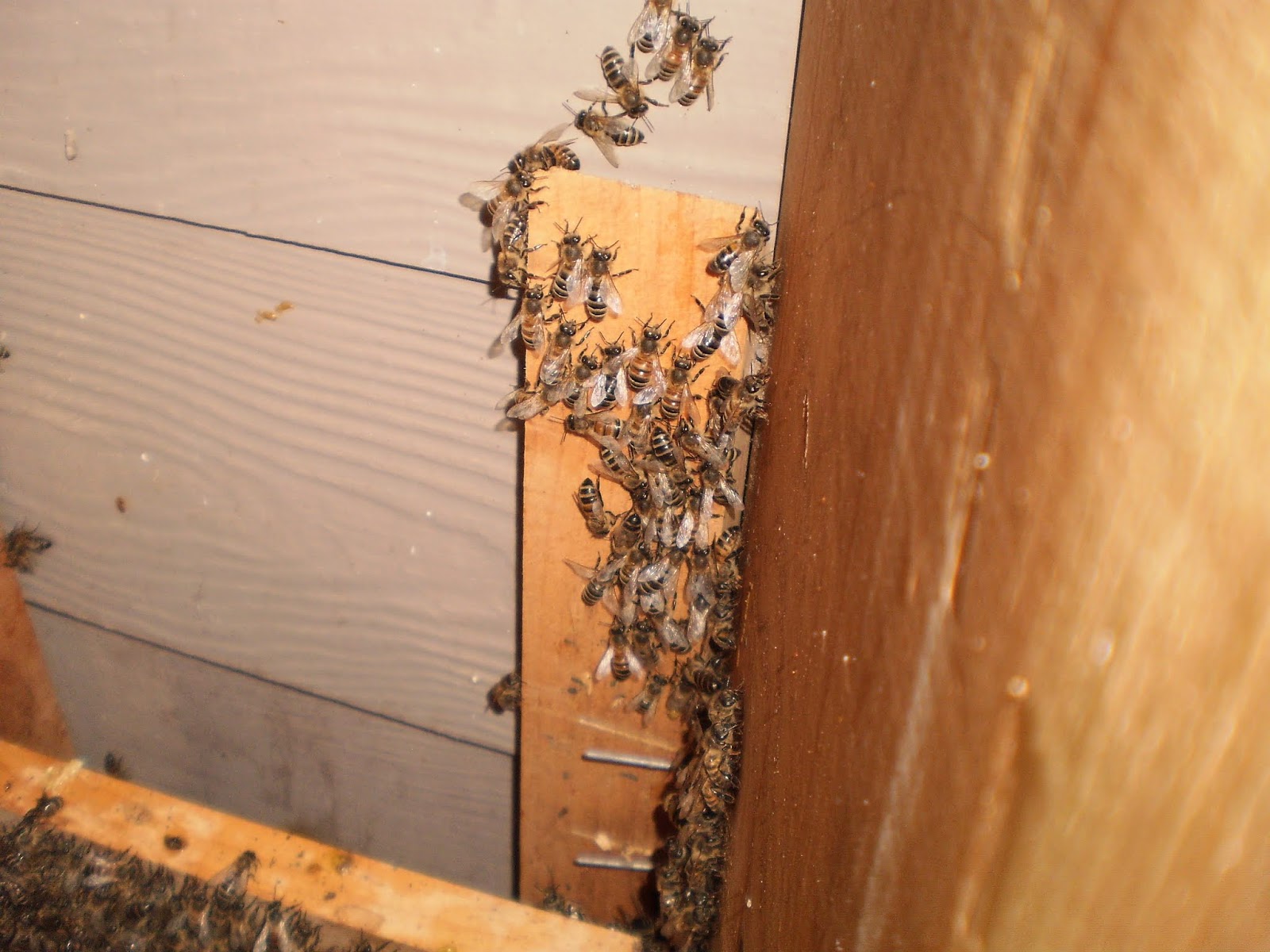 |
| Come out, come out, wherever you are... |
But the job is to remove the bees, so when I have removed as many as I can by other methods (singing to them, playing the fife, etc), I am pretty much left to remove them by sucking them into the vortex. By far my greatest draw is to put comb into the bucket, and let them move to protect the comb.
 |
| Light, delicious honeycomb. |
Once I had cleared the space up top, I moved to the lower level, where I removed the fascia board to reveal....
...more wood.
A bit anticlimactic. I had hoped to hear the roar of unhappy bees, preparing to do battle. Instead, I heard the thrum of bees going about their business: dehydrating nectar, stashing pollen, caring for brood. From behind another layer of 2x6 #2 spruce.
After poking and prodding for a bit to see what could be removed, I finally succeeded in removing a horizontal piece, revealing bees back and to the side. A very defensible position, the scout bees explained to me, as they offered to demonstrate the ways in which they were willing to make my life more difficult.
 Piece by piece, standing 13' off the ground on an aluminum ladder, I removed pieces of the hive until all the new comb was gone. Much like the other hive, these bees were a recent arrival. Lots of new, fresh comb with both larvae and light honey ready to be capped with a wax cover, eggs, and bright pollen filling cell after cell.
After I had safely removed the comb (and, honestly, feeling a little proud about how well I was doing) I dropped back down to re-evaluate.
 |
| Not much of an opening. |
I grabbed the flashlight and looked into the hole. To my surprise, an awful lot of bees looked back at me. From very far back in the cavity. I started reaching further back into the hole, making a bunch of bees very worried in the process, and I kept cutting comb. But this was not bright, white, or even yellow comb. This was old, dark comb. There were no eggs, pollen or honey in any of these pieces. These pieces of comb were left from last year's removal. And maybe before that.
I was reaching to the maximum extent my arm could reach, deep into the hole. And as much as I was extracting, there was more. This hive had extended deep into the area between the ceiling and the floor. And with every new patch of dark comb, more bees emerged.
I vacuumed again, and pulled out everything I could. Finishing up with a wipe down of the entire surface with ammonia (and the burst of escapee-bees in hiding that always seems to accompany that action), I then went to finish the job.

And be a carpenter. How hard can it be? I am not terribly handy, but surely I can put things back into the place I took them out of, and tack them back into place.
Of course, nothing fit back into the original space. I used a crowbar to force the column pieces back into place. I tacked, and caulked, and sprayed with a vile insecticide expanding foam sealer that I am still finding attached to my skin and my clothes in the most inexplicable places.
And after an hour of work, I had the column put back together.
A quick vacuum of the stray bees, and I went to work on the fascia for the lower hive.
Again, nothing fit. Nothing. Finally managed to cinch the horizontal piece back in place, together with the replacement duct tape and screen wire to secure the holes. And again, I caulked and sprayed foam to seal holes. As the foam would dry, I would run the vacuum again, to get more of the stray bees away.
Finally, after about ten hours of work on the ladder, I gave it up. I could not put the fascia board back in place, but I swept up the debris and explained the next steps to the tenant (and later in an email to the owner). After a week:
- Trim the foam.
- Replace the fascia board.
- Caulk and paint to reduce the risk of return.
I shared the honey, and left.

About a dozen stings, including a surprise one on the belly at the end of the day. But being able to complete the job, and share both bees and honey....
It feels good.
On to the next job.