Thursday, June 14, 2018

Don't Look - Long Way Down

I extended my 20' ladder to its full length, and placed it against the front wall of Mr. Stephen Edmonson's house.  I clambered up, I stood on the top available rung, and still fell about four feet short of being able to peer into the hive.

This beehive removal was going to be tricky.

Stephen has a lovely house over in Ridgeland, about a 45 minute drive from my house, and he has bees that have infested the corner of the house. As he explained it,
Last year, we had a huge swarm of bees out in the tree right there in the front yard last year, and they just stayed there for a long time - it was just amazing.  Eventually, they moved into that spot right there. Then a couple of months ago, the AC guy got stung a couple of times in my attic, and there are a lot of dead bees up there.  So I contacted another beekeeper, who just got too busy.... and then I called you.

From the top of the ladder, I was at a better vantage point, but it was also very clear that my ladder was not going to cut it.  It was also clear that there was NOTHING to hang onto. But the bees were industriously running in and out of the hive, bringing in their groceries and doing their bit to pollinate the world.

I came back and told Stephen, "I will need to get a better ladder, but I can do it.  I will need somebody to help with this one, just because it is high, though.  But we should be able to get it out of there with little problem.  I'll send you an estimate, and we'll schedule the work."

Armed with a sturdy rental ladder from Home Depot, I returned this past Saturday to take on the job, with a friend and beekeeper Shannen Blackledge.  Even with the taller ladder, though, the drop from the top was formidable.  My auditorium job (blog post still pending) was probably higher, but at least there were some branches to hang onto while I worked. Not so here...

Every removal job I have done has been an exercise in problem solving.  How do I get to the bees, how do I open the hole enough to get them out; how do I remove them safely (both safety for me and safety for them) and how do I keep them from returning?

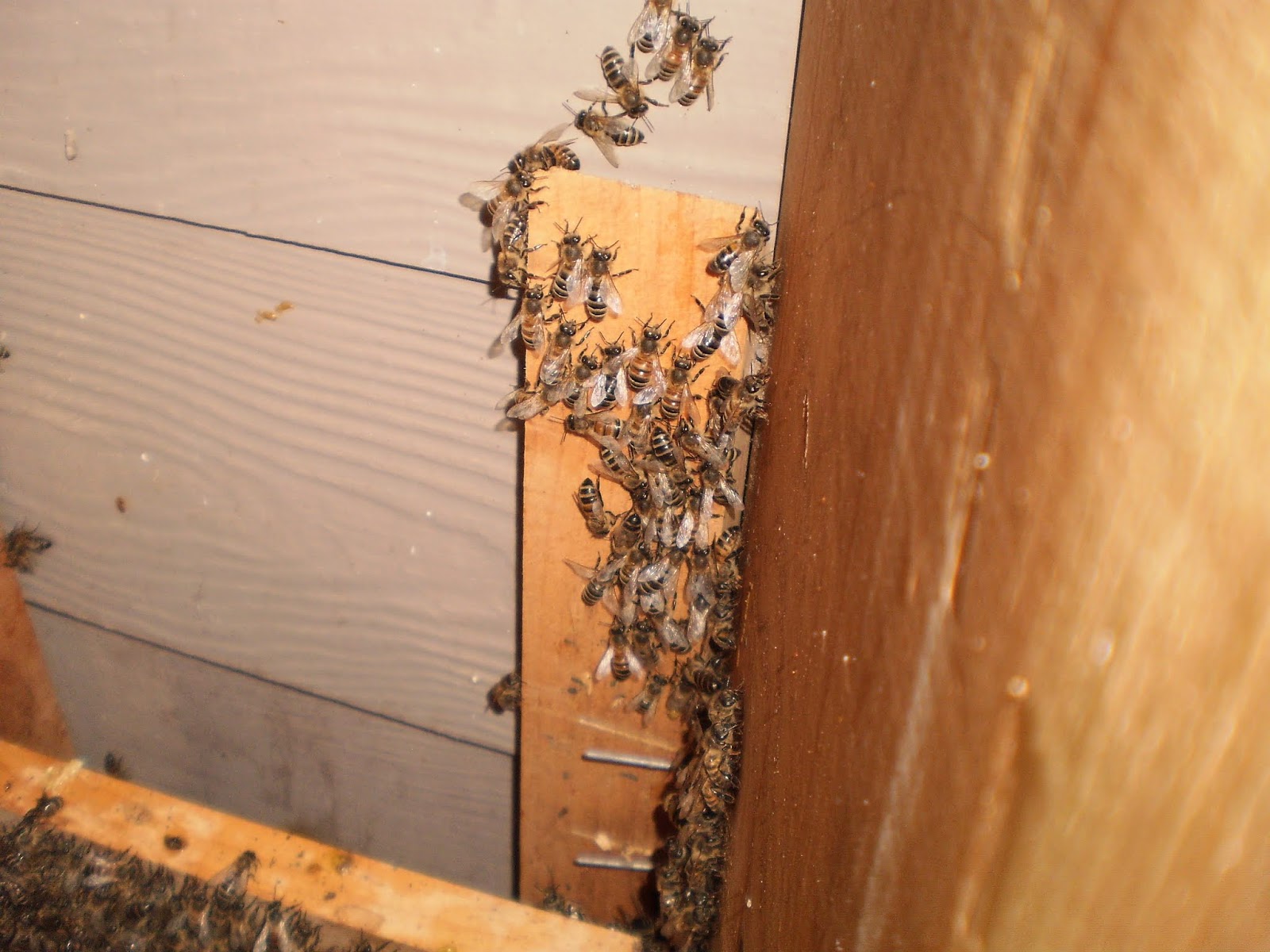
Finally started, I removed the molding on the face of the hive, and pried up the roofing just enough to see the extent of the comb.  And it was beautiful.  Layer after layer of beautiful, amber-colored comb. And curious bees looking back at me, without aggression or anger, just checking me out, then going back to clean up the mess I had already started to make.

That mess was about to get a whole lot worse.

Peeking inside.
I removed the shingles from the overhang (overbalancing once for a frightening moment).  And then tried to pry loose the waferboard (OSB) underneath.  The OSB extended under and through, and was tied into place from multiple directions.  After a half hour of trying to untie the Gordian knot, I got out the Sawzall, and cut through the OSB that capped the area. The comb was attached to the waferboard; removing it broke the very top of the comb off, and the delicious smell of honey permeated everything.  And the honey started to drip.

Honeycomb attached to waferboard
It dripped onto the ladder.  It dripped onto the light fixture.  I dripped onto the tarp (placed on the patio in an odd moment of foresight on my part) and onto me.  I invited Shannen to take a look from my perch on top of the ladder.  After a brief glance, her nice, clean suit was no longer either.

Then I started removing comb.  The first piece is almost always the toughest, as you have to try and remove the comb from the top, bottom, and sides, all without destroying the comb or spilling a drop of honey or pinching a bee or overbalancing.

...revealed more beneath.
This time, I successfully used a combination of bbq tongs and a long, thin jabsaw that let me cut the pieces free by sliding between the pieces of comb. What surprised me was how far back I could feel the comb.  The open space between combs extended more than 3 feet back... well beyond where I should have encountered the brick of the wall.  Oh, man, I thought.  This is going to be a MUCH bigger job than I thought.

A few more pieces of comb removed, and it was clear what had happened.  Instead of brick, there was foil-backed styrofoam board, covering an opening in the wall.  The bees had chewed through the styrofoam, and the ladies had built two combs and filled one with honey.

This was how the girls were getting into the attic. This was how the AC guy got stung.

Meanwhile, I am frantically looking for the queen.  My previous removals have not resulted in complete success, because I did not find the queen, and separate her out.  In one removal, she escaped and hid, only to return to the scene and instruct her followers to build more comb.  In another, I feel sure she got smushed by the vacuum (I have since lowered the amount of suction I use).  None has resulted in a queen that is viable.

So this time, I am on the lookout.  I extract a bee with an enormous abdomen, and am thrilled.  I have found the queen! Then I find another.  And another.

Apparently, this whole race of bees has huge distended abdomens.  And because they are coated in honey, it is hard to tell.  (Eventually, I captured her.  I think).

Finally, after dozens of trips up and down the ladder, each time carrying more brood and honey and comb down from the perch, and each time smearing more honey onto each rung of the ladder, I had hit the end of what I could reach.

There were still eight pieces of comb that needed to be removed.  And I had no real way to get to them.  The remainder were bracketed by multiple 2x4s, and closed in - completely inaccessible.  I reached in to cut the next one free, but every time I would reach to retrieve it, I would only manage to push it further away.

By this time, I had worked the site from 9:30 to mid afternoon, and I was getting tired and a little more accident prone.  I had managed to stave off a couple of slips (note to self: buy shoes with better traction) and a sickening slide of the ladder against the now-slick brick of the building (note to self: buy a ladder stabilizer) and a scary moment with the Sawzall (note to self:....um.)

Honeycomb's big, yeah, yeah, yeah...
I worked out the only solution I could come up with.  One more board was removed from the front - a small section of 2x4 that ran along the face of the opening.  Once I removed that piece, I had access to the remainder of the comb, which was very fresh, bright, new comb with pure honey inside.

All of the family - Stephen, his wife, and his four beautiful kids - all got in on the action at different points in the day.  For them, and for the passersby that stopped to ask us questions, we carved out and shared honey.

Then took the rest back with us.  (Where it now sits, in mason jars, ready for consumption....).  And finally, the removal of the comb was complete.

All (all!) that remained at this point was removal of the bees, cleaning the empty space, and relocating the bees to a new home.

It had already been a long day at this point, and it was not getting any shorter.  Shannen put another bottle of water in my hand - she had been carefully monitoring me for dehydration all day long, and fed me bottle after bottle of water.  A true life saver.

I attached my beevac to the shorter ladder and climbed up three more times to remove as many bees as I could reach.  Many would come back from the field later that evening and next day, but I managed to fill three buckets with bees, each getting set aside for placement once we got the comb moved to a new location.

I doused the entire opening with ammonia, which got the bees excited, but did not induce them to leave.  Finally, once the majority of the sticky mess had been turned into an ammonia-y mess, And most of the bees were gone, I added the poison to keep them from coming back and reoccupying the DMZ.


The final step was to get the bees installed in a new home.  I considered all my options.  The ones I favored all involved 3Bs - beer, benadryl, and bed, and leaving the bees for the next day.  But to give them the best chance at survival, I needed to get them into a new home as soon as possible.

I finally decided that I would drop them into a top-bar hive on Eddie Brook's property.  Two different removals have ended up on Eddie's doorstep, and one of the hives had completely absconded, so there was space.

I cut comb, wrapped rubber bands around the comb, and strapped the pieces on a top bar, fitting them into the box.  Then I suited up, and dumped all three buckets of bees into their new home, wishing them luck and leaving them behind. So that I could head to a place where three different Bs awaited my attention.

Reports from the field:

From Mr. Edmonson, following the removal:  On Sunday there was a huge swarm of them all around our house. Hundreds where you removed the hive. We almost couldn't go outside, they were attacking us in the front and back yard. We left after lunch on Sunday and just got back this afternoon. I looked up at the hive area, and I could see no more than 3 bees buzzing around and a lot of dead ones on the ground. So you must have gotten the queen.

And from Eddie Brooks:  There are LOTS of bees buzzing and happy around the new hive.  They look good.

Some Lessons Learned:

  • Ladder stabilizers are a must for high jobs.
  • Bring the top bar hive with you so you can tie off comb as you remove it.
  • More tupperware will always be needed.
  • Benadryl tablets might not be a bad thing to bring along. 
  • Hornet spray splatters back on you (and burns!) at close range.
  • Granola bars are a requirement.  A full meal in the middle of the day would be bad, but hunger at the end of the day is bad, too.
End result, I think this will be a success.  The bees are now no longer in the house, and a carpenter can come and do the repair work without fear of being stung.  And the bees have a new home that they can live in, with attention and care being paid to their well being.

Can't wait to see them building more comb.


Tuesday, June 5, 2018

The Miraculous Fount of Sister So-and-So

The bees covered the floor of the classroom, all dead.  Layered on the floor in front of the 12' window, their carcasses were dried and dusty.  Every horizontal surface within twenty feet was covered with the bodies. One sad, exhausted - but still alive - bee beat her wings against the window, trying in a vain attempt to escape to the outside where nectar and pollen awaited.


The location was the Southern Cultural Heritage Foundation, housed in a beautiful building from the 19th century.  The problem was not the dead bees in the classroom.

The problem was the honey dripping down the walls of the auditorium.

Last Thursday evening I saw a Facebook message on the Central Mississippi Beekeepers Association page.  It read:


A follow up message came a few minutes later.

Subject: Bees at the Southern Cultural Heritage Complex-- Vicksburg, MS
The bees are in the attic and honey is leaking though the ceiling! This is the Catholic Complex -- Was St. Francis of Xavier Convent and School before being bought by Southern Cultural. They plan to exterminate the hive if they cannot find someone to get it out. My son works there -- call 769-798-3216 and ask for Isaac. There is an event in the building this Saturday so they have to do something one way or the other by then. Thanks, FH

That location is three blocks from my work.  The people are all friends I have worked with before.  It was the perfect job for me to go and take a look.

When I got there, the task was much more daunting than I had thought.  I knew beforehand that the ceilings were high.  But this?  This is ridiculous.

You all know the auditorium - it was the set for the political rally in the movie O Brother Where Art Thou? The auditorium has beautiful plaster leading up to a gorgeous old wood ceiling.  The building dates to the 1880s, and is part of a complex that dates to the 1830s.  It belonged to the Sisters of Mercy, who focused on educating children in Vicksburg from the 19th century onward.

There is a lot of history there.

Understandably, there is also a certain reluctance to indiscriminate ripping out of portions of old walls to get at honeybee hives in the walls.  That means constraints on how I do my bee removal job.  Preference to avoid damage to the walls inside.  To avoid damage to the floors upstairs.  To avoid any impact to the exterior of the building.

Quite a lot of restrictions, but I understand them all; I am both an antiquarian and a preservationist.  So this fits right in with what I was feeling.  But it promised to my my work a lot harder.

First step, though, is to find the bees.
I walked through the areas impacted by the bees, and to everyone's surprise, the bees were not there.

No bees.

The dark stain is oozing honey.
OK, so that is not entirely true.  There were bees on the outside wall, licking up honey from the side of the building, where honey was oozing through the mortar.  There were bees buzzing around the gutter.  And the one, lonely, exhausted bee on the inside window upstairs. But what I expected to see was a group of bees, working to cool the entrance to the hive.

There were no such bees.

So the brainstorming began.  My coworker LeeAnn and I  joined Stacey Mahoney, the director of the center, Isaac, the caretaker of the facilities, and Nancy Bell, the director, and we looked at the classroom, at the auditorium, and the outside.

The place is haunted (so says an ex-employee), and so we discussed the idea of the Ghost Bees - that the bees were all dead, and that they were just creating a wall-ooze to frighten us.  Plausible.  We also discussed whether the bees were simply scared to death by the ghosts that haunt the place.  Sure.  Why not?  But the best line of the day went to Nancy Bell:

Me, pointing to the wall with honey dripping out: Do you know what this reminds me of?
Nancy Bell: The Amityville Horror?
Me:  Well, NOW it does.

(I later recanted, wishing that I had said Zombees from the start.)

After observing the situation from the approach, the getaway, the northwest corner, the southwest corner.... I finally told them I didn't think that the bees had stayed.  I gave my reasons:

  • No entrance.  There are bees around the gutter, and other bees along the honey stain on the outside wall of the building. But as I mentioned before, with temperatures hovering around 95 degrees, there would be a beard of bees expected, and a high number of bees entering and exiting constantly from some location near the stain.
  • Honey stain.  The honey that was dripping from both inside and outside walls indicates that the bees are not caring for the hive. If bees were present in the hive, they would be working to regulate the temperature of the hive and to reinforce any breach of the honey resources.  
  • Dead bees.  Dead bees in the upstairs indicated significant activity in the wall, with some access to the room.  But the absence of live bees of any serious quantity (I only observed two inside the whole time we were there) indicates that the bees were no longer entering from the original location.  
The original hive likely had an opening that was explored by bees, who could not return through the same location, and became trapped in the room.  Attracted to the light of the window, they died and dropped to the floor.  Once the bees were no longer in the walls. Far fewer were redirected into the room.

There are a bunch of reasons why a hive of bees would leave an established home - what we refer to as absconding.  I explained it in terms of moving into an apartment complex: If you find out it is uncomfortable (temperature, disturbances, too crowded, poor ventilation, etc) you take whatever you can from the apartment and move.  You can also have a problem with the queen, and the hive will abscond.  

But mostly, we don't have any idea WHY they left.  We just know that they did.

Once they left, the temperature inside the walls got high, the wax in the hive left behind began to deform, and honey began to leak from the comb.  Meanwhile, with no bees there to protect their resources, the honey started to flow. It traveled down the wall from its original location, and pooled at the first location where a cross bar prevented further downward flow. At that point, the warm, less viscous honey exploited every crevice to flow out of the location.

Both inside and outside.

The problem, I explained, is now quite firmly not a beekeeper problem.  But rather a how-do-we-get-the-honey-out-of-the-walls problem.

Brainstorming continued.  A tongue-in-cheek suggestion was floated that we refer to it as a miraculous font ("Of Sister So-and-So") and charge donors $100 for a portion of the honey.

Finally, we agreed to the drilling of small holes at the ceiling line inside, to allow the honey to drain out from the walls, but with a straw (or plastic tube) inserted to direct the flow to a place where it could be collected.  Instead of the way it was: dripping down the walls.

An hour later, I had several small holes, invisible from the ground level, and straws (which were VERY visible from the ground level) inserted.  And no flow at all.

A few modifications later, I reported back to Stacey what I had done.

Me:  So, do you want the two pieces of good news, or the one piece of bad news?
Stacey:  There is good news?  Give me that.
Me: Good news #1.  I was right.  There were no bees.  That means when I drilled the hole in the wall, no horde of angry bees filled the entire auditorium.  I guess that is more of a 'not bad news' than a truly 'good news' story, but I work with what I can.
Stacey:....
Me: Good news #2:  There is not a huge quantity of honey in the walls.  A full hive can have 100 pounds of honey - about 8 gallons (I think I actually said 12 gallons...).  And with that much honey in the walls, you would have a spurt of honey when you opened a hole in the walls.  And we didn't.
Stacey:  That is good news, I guess.
Me:  ...which leads to the bad news.  The straws did not serve to divert the honey.  There was not any build up inside the walls that I could find with the holes that I drilled.  So what I did was to stuff paper towels in each crevice where honey was seeping out.  The paper towels will eventually saturate, and will have to be replaced, but for the short term, you should be able to clean the floor and not have drips.  At least for a few days.

I am headed back tomorrow to put the ladder back up, wipe everything down, and insert a dowel and some putty into the hole.  But in the meantime, I will just pray for the soul of Sister So-and-So, and maybe find a market for the honey from her Zombees.


Friday, May 18, 2018

Removals (x2)

"I am reading through this contract, and the way I read it, you will not replace the work that you tear out.  Am I reading that right?"

It is a fair question.  A fair thing to ask.  Mr. Victor Robinson has a tenant who was looking to have bees removed from his back porch, and I had gone over for an inspection and had discovered two separate hives - one on each level of the condo.  I had modified the contract accordingly and emailed it to him.

"Sir, I am a bee removal specialist," I explained.  "I am not a specialist in construction.  To be perfectly honest, as much as I don't want to be your carpenter, the truth is, you do not want me to be your construction specialist.  Jack-leg does not even begin to cover it."

"When Mr. Ervin did it last year, he replaced the boards and closed it up."

Sid Ervin is a legend hereabouts, and with good reason.  He did amazing work all across the state, opening up buildings with an absolute minimum of fuss, removed the bees that he could, poisoning the bees that remained, sealing up the hole, and leaving.  He earned his money; he was good at the work, and there was quite a demand.

But I had just finished a job where I drilled into plaster, and was (am) still working on a job that involved brick.  Recent experience has already shown me my limitations in a painful way.  It was a critical moment for a critical question. "If it is as simple as tacking a board back in place, I will do that.  But anything beyond that is beyond my carpentry skills."

We agreed, and I received the contract by email later that day.  And Monday, I gathered all of the items that I thought I would need and drove an hour over to Brandon Mississippi, to remove bees.

According to Charles Smith (I had a moment of panic when I was told that his name was Charles Smith, since that was also the name of my LAST job - I worried that I had gotten the name wrong on my first ever invoice....), the bees had appeared a little over a week earlier, and just completely covered the porch.  It was a very large swarm, and within a day, they had disappeared.  Into the column.

With a week's growth, I figured it was a good time to do the removal.  The bees would have had little time to build the comb, and it would not be terribly messy with only limited brood and comb.

I was wrong.  Very wrong.  Holy honeypot, the amount of work bees can do in a week when they are motivated is astounding.

Pure uncapped honey from the first step of opening the hive.
The only time I had watched bees begin to build a hive was at my house from the swarm collected from Drummond St., between the house of Launo Moore and Jill and Tony Bishop.  So I though I knew how fast the girls would build comb.

These girls swarmed just as the flowers were blooming, and there were resources.  It was also a much larger swarm, and they got busy.

I opened the top of the column, and immediately had honey to collect.  I went inside and snagged a small tupperware piece from the kitchen counter, salvaged some of the honey, and covered it for sharing.  With people, not with bees.  They can fend for themselves.

Opening the column.
Kathe had sent me on my previous removal mission with a set of barbecue tongs, and I found them enormously helpful in holding the comb in place with a minimum of damage.  My previous experience at the house in Vicksburg left me a little scarred on how much damage I had done to the brood comb, and I did not want to repeat the mistakes.  I was pleased with how they worked.  I might even use the tongs/spatula combo I have in the drawer for future removals.

The comb came out cleanly, with a minimum of fuss.  The latex gloves I wore kept tearing, and were discarded quickly, but all in all they served well.  Stings were lifted off the skin, and swelling fingers kept to a minimum (my ring mentioned in a previous entry still has not been repaired.)

Ollie, ollie, oxen free!
But I got the comb.  And the bees.  They were not happy about the situation, but that is not an expected outcome anyway.  Once I had removed the majority of the bees, I opened the side of the (square) column, and removed the rest, while providing remaining bees a chance to congregate at the central location.  I did not find the queen, but played an intense game of hide-and-seek for several hours, trying to figure out which section of the hive she was under, which board she was hiding behind, or what disguise she was wearing (I'm just a normal bee, nothing but a worker bee.....).  She also (quite cleverly) dressed up 8,000 of her closest relatives to look just like her.


Come out, come out, wherever you are...
And, yes, I am still tinkering with the vacuum.  The draw is too strong, and many of the bees are damaged in the process, so I am trying to use the beevac as infrequently as possible.

But the job is to remove the bees, so when I have removed as many as I can by other methods (singing to them, playing the fife, etc), I am pretty much left to remove them by sucking them into the vortex.  By far my greatest draw is to put comb into the bucket, and let them move to protect the comb.

Light, delicious honeycomb.
The comb was almost preternaturally bright.  This was not old comb - Charles was right that they were newly occupying the space - the comb was less than two weeks old.  And already they were drawing honey - light, sweet honey.

Once I had cleared the space up top, I moved to the lower level, where I removed the fascia board to reveal....

...more wood.

A bit anticlimactic.  I had hoped to hear the roar of unhappy bees, preparing to do battle.  Instead, I heard the thrum of bees going about their business: dehydrating nectar, stashing pollen, caring for brood.  From behind another layer of 2x6 #2 spruce.

After poking and prodding for a bit to see what could be removed, I finally succeeded in removing a horizontal piece, revealing bees back and to the side.  A very defensible position, the scout bees explained to me, as they offered to demonstrate the ways in which they were willing to make my life more difficult.

Piece by piece, standing 13' off the ground on an aluminum ladder, I removed pieces of the hive until all the new comb was gone.  Much like the other hive, these bees were a recent arrival.  Lots of new, fresh comb with both larvae and light honey ready to be capped with a wax cover, eggs, and bright pollen filling cell after cell.

After I had safely removed the comb (and, honestly, feeling a little proud about how well I was doing) I dropped back down to re-evaluate.

Not much of an opening.
Truthfully, being on a ladder, the phrase 'pride goeth before a fall' occurred to me more than once.  But everything up until this point had been pretty solid.

I grabbed the flashlight and looked into the hole.  To my surprise, an awful lot of bees looked back at me.  From very far back in the cavity.  I started reaching further back into the hole, making a bunch of bees very worried in the process, and I kept cutting comb.  But this was not bright, white, or even yellow comb.  This was old, dark comb.  There were no eggs, pollen or honey in any of these pieces.  These pieces of comb were left from last year's removal.  And maybe before that.

I was reaching to the maximum extent my arm could reach, deep into the hole.  And as much as I was extracting, there was more.  This hive had extended deep into the area between the ceiling and the floor.  And with every new patch of dark comb, more bees emerged.

I vacuumed again, and pulled out everything I could.  Finishing up with a wipe down of the entire surface with ammonia (and the burst of escapee-bees in hiding that always seems to accompany that action), I then went to finish the job.


And be a carpenter.  How hard can it be?  I am not terribly handy, but surely I can put things back into the place I took them out of, and tack them back into place.

Of course, nothing fit back into the original space.  I used a crowbar to force the column pieces back into place.  I tacked, and caulked, and sprayed with a vile insecticide expanding foam sealer that I am still finding attached to my skin and my clothes in the most inexplicable places.

And after an hour of work, I had the column put back together.

A quick vacuum of the stray bees, and I went to work on the fascia for the lower hive.

Again, nothing fit.  Nothing.  Finally managed to cinch the horizontal piece back in place, together with the replacement duct tape and screen wire to secure the holes.  And again, I caulked and sprayed foam to seal holes.  As the foam would dry, I would run the vacuum again, to get more of the stray bees away.

Finally, after about ten hours of work on the ladder, I gave it up.  I could not put the fascia board back in place, but I swept up the debris and explained the next steps to the tenant (and later in an email to the owner).  After a week:

  • Trim the foam.  
  • Replace the fascia board.  
  • Caulk and paint to reduce the risk of return.

I shared the honey, and left.


All in all, not bad.  I took the bees and comb by a friend who keeps bees, and set him up with two potential hives, all ready for him to raise.  And made it home in time for a laaate dinner that Kathe had prepared.

About a dozen stings, including a surprise one on the belly at the end of the day.  But being able to complete the job, and share both bees and honey....

It feels good.

On to the next job.


Sunday, May 13, 2018

Bees Inside


Bee-tween
the window and the drapes.
I love bees.  Bees are a delightful part of nature.

But. 

Nature, I am told, is intended to remain outside the walls of our homes.  To establish our safe haven within a location of our choosing, we beat back the weeds and the animals and the insects, and we sanitize and create our space to our own desires.

Our space. 

Very rarely are bees expected to be part of that space. And certainly, any situation where bees have unfettered access to that space is to be avoided.

Last week I got a message.
Facebook message from Mr. Smith's sister, Portia

Bees.  Inside.

As my sister said, "Nope."

The house is beautiful.  It is made to look like the limestone that faces the buildings at the front of the Tulane campus, and has a lovely feature (tower? keep? machicolations? I don't know.) on the southeast side of the house. When the owners got in touch with me, they referred to the house as The Castle House.  Originally from Vicksburg, they had purchased the house as a family home, eventually to be passed on to their granddaughter.

And there are bees inside the house.

Nope.


So my job was to remove the bees from a beautiful, turn-of-the-century home.  My goal was to remove them safely, get the queen ensconced in a new hive, and bring enough of her loyal subjects and resources to get the hive started in a new place where they could thrive.

My job has been done.  The bees are no longer in the house.
Bees entering from the base of the window.

I did NOT, however, reach my goal.

The whole job was a learning experience, and there were a host of unknowns from the start.  How far down did the bees go?  How far up?  Which studs defined the limits of their space?  How were they getting into the house?  

The first piece that provided a difficulty was the shape of the room.  Yes, the room the bees decided to inhabit was a circular room.  The plaster work for the room was done at a time - back in the early 1900s - when work in plaster was a common craft.  

Nowadays, to find a good plaster guy, you will pay big.

My first schematic.
The bee bag got drawn into the hose
at the bottom, clogging it.
I promised Mr. Smith that I would cut as little as possible to remove the bees.  My first step was to drill a hole in the wall, allowing the bees a specific place to escape.  I would use my beevac to suck them up.

Now Best Beloved, my beevac needed some tinkering.  On a different job, the suction completely disappeared, while I was up on a 30' ladder.  Situation: less than ideal.  So with the help of my inventor-brother Parker, I modified the design so that I could draw the bees through the hose and into the bucket/bag combination.

Parker's suggestion was to add a tube at the bottom, and perforate it, so that there were more than one place for the vacuum to draw.  It was similar to the design I had originally used - before the introduction of the paint-strainer-as-bee-bag.

The draw, as a result of his suggestion, was vastly improved.  

I drilled holes in the wall of the upstairs room in The Castle House, and the bees began to emerge.  Because I was working inside, I could not use the smoke to calm them down - there is something about bedsheets and mattresses and smoke that don't mix.

So I beevacked.  Slowly, the numbers of curious bees started to abate, and I cut the hole open wider.  The opening ended up being about 18" high by 12" wide - enough to get my gloved hand in with the vacuum, but not much room for maneuvering. 

And there were bees downstairs as well, which meant that it was possible that the hive extended below the floor and into the wall on the first floor - a big uncertainty that I needed to deal with eventually.  But first, I had to start removing the comb.  

The first bit of comb I encountered was old, abandoned comb - the bees had gone lower in the wall since they had built that first piece.  To get the comb out easily, I was going to have to expand.

Discussions with Mr. Smith did not get far.  I wanted to cut through the base board precisely, to expose more of the comb so I could remove it carefully. I do understand his response ("No.") because replacing it would be tough, no matter how careful I was.  I used to work for a company that manufactured molding.  Curved molding is an expensive product.

Below the sill, above the baseboard, between the studs.
I also floated the idea of opening the wall downstairs, if the hive extended that far.  That was also met with a negative response.  Again, understandable.  The replacement of plaster on one opening in one room on the second floor is expensive, but doable.  The downstairs room, though, is pretty much the centerpiece of the home.  "Crorey, if the bees extend down that far, we will just have to fill them in; I can't open the wall downstairs."

I continued to remove comb.  At first, all of the comb was empty, with no honey or brood or pollen.  As I got lower, there was brood.  And as carefully as I tried to extract it, I bruised all of the comb as it was coming out, damaging larvae and pupae as I did so.  

Meanwhile, the vacuum continued to do its work. 

At one point, I left the beevac running, with the hose in the wall, and went downstairs for a glass of water.  When I returned, the hose had fallen out of the wall, and there were a large number of bees that had wandered up to investigate the new situation.
Veil up selfie.  The way it should be.

I ran over to the hole, and began vacuuming them up, and they reacted predictably.

Ow.  OW.  OWW!

It was at this point that I decided to pull the veil back over over my head.  Something I should have done BEFORE I approached the bees, but in my haste to prevent a bee jailbreak, I forgot.  Nose, scalp, scalp.  Not bad, considering, but a definite reminder to slow down and then react, rather than react first, and then think....

I continued to remove comb, encountering a nail in the wall that limited my access, and eventually encountering a floorboard that extended into the wall space, as well.  Each piece of comb removed was preceded by multiple attempts to remove the bees into the beevac.  
Old, disused comb.
Another 18" of removed comb.  Nail between wall and siding.

Nail removed, more comb removed, revealing floor board obstruction.
Comb.  Sadly, I was not able to remove the brood comb intact. 
Beneath the floorboard was the best brood comb I encountered.  Removing it required that I reach under the floorboard, grasp the comb, break it free, and then snake it out through the opening between the wall, stud, siding, and floorboard.  All while wearing a glove to ensure that I got stung the fewest times possible.

Eventually I had to remove the glove, and dive into that space barehanded, to retrieve the comb.

The comb extended to the ceiling of the first floor, where I hit a hard surface.  The rest of the afternoon was spent removing the fragments of comb from different crevices across the opening.    

Closed up the hole, vacuumed up debris, and ready to go.
Once all of the comb was removed, I wiped all the interior surfaces down with ammonia.  Several bees who had hidden in different places in the hole suddenly erupted into the room, more than a little upset at having been gassed out of their game of hide-and-seek.  After consigning them to the interior of the bee vac, I sealed the inside corner with foam sealer, closed up the hole, and vacuumed up the remaining plaster and wood, dead bees and comb from the room.

I then took the vacuumed bees home, and placed them in a hive box.  I never saw the queen, and suspect that she was KIA.  I remain very conflicted about removal that does not net the queen, because it means I still have a lot to learn.  

I finalized the process by climbing up to seal the exterior with silicone.  And the job was done. 

The job was done.  But the goal still remains.  I want to do better.  I want to improve the bee vac to make it gentler on the bees.  I want to take my time and find the queen, so that I can complete the task and introduce the bees to a new home.

Mr. Smith wore my spare veil while I transferred bees from vac to bucket.